Версия книги на русском
En español
Em português
Auf Deutsch
En français
In italiano
In het Nederlands
På svenska
Suomeksi
På norsk
På dansk
日本語で
हिंदी में
|
You are on the page: Scriptures.ru ➤ Books ➤ The ultimate meditation guide
|
Vasyl Vernyhora
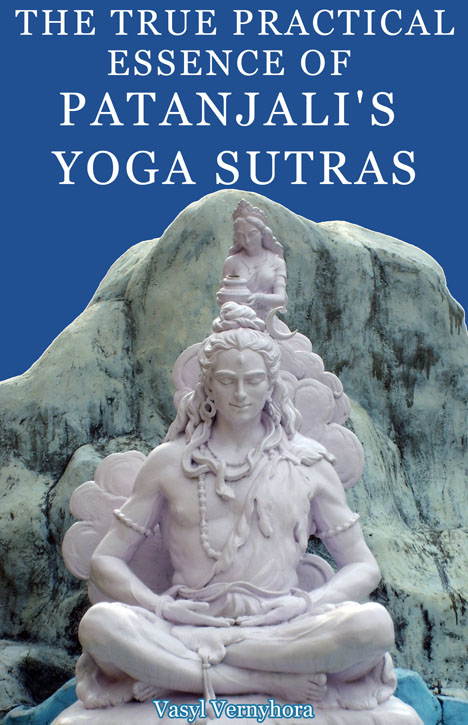
"The true practical essence of Patanjali's Yoga Sutras"
|
|
|
Версія книги українською (2) Версия книги на русском En español Em português Auf Deutsch En français In italiano In het Nederlands På svenska Suomeksi På norsk På dansk 日本語で हिंदी में |
"The true practical essence of Patanjali's Yoga Sutras" by Vasyl Vernyhora presents a complete, carefully verified and meaningful translation of the key text of yoga—the Yoga Sutras of Patanjali. The translation not only preserves and conveys the original meaning of the sutras without confusing, quasi-philosophical formulations, but also includes commentary where additional clarification and comparisons with other yoga and Buddhist texts are needed. The book presents the original essence of the concepts of eightfold yoga, including pranayama, pratyahara, dharana, dhyana, and samadhi, the true method and meaning of samyama, as well as other aspects of Patanjali's teachings, based on a thorough analysis of the Yoga Sutras and its comparison with the original teachings of the Buddha, which, in turn, were based on the teachings of the ancient yoga of that time.
Although the surviving text of the Yoga Sutras, in addition to several stages of "yogic" editing, also bears obvious traces of Buddhist influences, it is now difficult to determine the reasons for their appearance. For example, this could have been due to the deliberate editing of this yogic text by Buddhists or yogis with Buddhist views. Or it could have been due to the fact that at the time the Yoga Sutras were written, yoga and Buddhism coexisted in the same territory of Hindustan, using the same languages of the time, primarily Sanskrit and its variations. Moreover, the Buddha's own teaching was almost entirely based on the teachings of contemporary yoga, which he purged of accumulated superstitions and useless distortions (including torture of the flesh) of an even older teaching. Although both yoga and Buddhism continued to evolve after the Buddha, the interpenetration of these teachings continued to take place, and the text of the Yoga Sutras perhaps serves as one of the best confirmations of this.
This is not just another translation of the Yoga Sutras from Sanskrit. You may discover for the first time the hidden meaning of sutras 1.17, 2.47, 3.4, and many others. The distinctive features of this edition are, firstly, a carefully verified and meaningful translation, executed in a manner that preserves and conveys the original meaning of the sutras without confusing, quasi-philosophical formulations. Commentaries have been added to the translations of the sutras where additional clarification and comparisons with other yogic and Buddhist texts are needed. Secondly, the practical focus of this edition allows for a true understanding of the method proposed by the author of the Yoga Sutras for achieving the goal of yogic teaching—the development of superconsciousness. Applying this method enables the reader to personally achieve this goal.
What's important is that the teachings of both Patanjali and Buddha have proven effective in achieving superconsciousness. As the saying goes, they are all-powerful because they are true—and they really are.
I hope this comparative analysis of Patanjali's aphorisms and the Buddha's teachings will allow the reader to fill in the gaps in the extremely condensed description of the practice of samadhi in the Yoga Sutras. And perhaps it will encourage them to once again practice this transcendental teaching of Patanjali.
Contents
Introduction 1
Interpretation of key sutras 1.2, 2.54 and 3.1-5 of Patanjali's Yoga Sutras in the context of Buddha's teachings 6
Correspondence of yogic dharana with aspects of Buddhist practice 15
The correspondence of yogic dhyana to aspects of Buddhist practice 19
Comparison of yogic pratyahara, dharana and dhyana with Buddhist samprajnata, ekagrata and smriti 22
Interpretation of Sutra 3.4 in the context of aspects of the cumulative practice of samadhi 27
The word "samyama" in other texts of yoga, Buddhism and Jainism 32
Sutra 3.4 in the context of the practice of dharana, dhyana, and samadhi as stages 33
A version of the origin of the word "samyama" from Buddhism 35
Disruption of the sequential flow of presentation in sutras 2.45-48 and further 39
Description of the essence of pranayama in the practice of samadhi in sutras 2.49-53 and 1.41 43
Obstacles to the practice of samadhi listed in sutra 1.30 54
Methods for countering obstacles in the practice of samadhi, given in sutras 1.32-39, 1.12-14, 1.21-23 56
An overview of sutra 1.17 in the context of the description of the first jhana/dhyana of Buddhism 64
Overview of sutras 1.18-20—arhatship and reincarnation 70
Sutras 1.27-28—Pranava-Om̐ and the practice of meditation 75
Sutras 1.42-51—a selective description of the rupa-dhyanas and arupa-ayatanas 79
Sutras 3.6-15 on one of the methods of practicing samadhi 97
The full text of Patanjali's Yoga Sutras 111
Chapter 1
On concentration (Samadhi-pada) 111
Chapter 2
On practice (Sadhana-pada) 116
Chapter 3
On superpowers (Vibhuti-pada) 122
Chapter 4
On liberation (Kaivalya-pada) 133
About sutra 1.2 and the Four Noble Truths of Buddhism 146
Comparison of the tenth stage of the Noble Tenfold Path of Buddhism and Hindu Moksha 148
Conclusion 149
Other books by the author 153
Below is an excerpt from the book with a translation of all the sutras of Patanjali's "Yoga Sutras", but without comments.
Sutras marked * are commented in detail in Vasyl Vernyhora's book "The True Practical Essence of Patanjali's "Yoga Sutras".
Chapter 1
On concentration (Samadhi-pada)
1.1. So now (atha) the instruction (anuśāsana) about yoga (yoga).*[6]
1.2. Yoga is the curbing (nirodha) of fluctuations (vṛtti) on the “mirror of the mind” (citta).*
1.3. Then (tadā; i.e., when the disturbances-vṛtti are curbed) there occurs abiding (avasthānam) in the one's own (essential) nature (sva-rūpe) [of the] observer (draṣṭuḥ).*
1.4. In other cases (itaratra) [there is] identity (sārūpya) [of the seer] with the impressions-vṛtti (vṛtti) [on the mirror of the mind].*
1.5. The [mental] modifications-vrittis (vṛtti), which form a group of 5 aspects (pañcatayya), can be based or not based on the kleshas (kliṣṭā-akliṣṭā; kleśa: obscurations of consciousness, sufferings).
1.6. Right knowledge (pramāṇa), false knowledge (viparyaya), verbal knowledge of something non-existent (vikalpa), deep sleep (nidrā) and recollection (smṛti) [are the five modifications-vrittis on the mirror of the mind].
1.7. Direct perception (pratyakṣa), inference (anumāna) and testimony (āgama) are right knowledge (pramāṇa).
1.8. False knowledge (viparyaya) is illusory (mithyā) knowledge (jñāna) based (pratiṣṭha) on mistaking a particular form for something entirely different (atad-rūpa).
1.9. Verbal knowledge of something non-existent (vikalpa) comes from (anupātī) verbal (śabda) knowledge (jñāna) of something that does not have (śūnya, "empty") real existence (vastu, "that which is").
1.10. The vṛtti-modification (vṛtti) [known as] deep sleep (nidrā) is based (ālambanā) on the mental state (pratyaya) of absence (abhāva) [of perceptions].
1.11. Remembrance (smṛti) is the reproduction, without taking anything from other sources (asampramoṣa), of such a thing (viṣaya) that was previously experienced/perceived (anubhūta).
1.12. The taming (nirodha) of this (tad; i.e. mental modifications-vritti[7]) occurs through practice (abhyāsa) and non-attachment (vairāgya).*
1.13. Abhyāsa, or practice (abhyāsa), is the effort (yatna) to achieve this (tatra) mental peace/balance (sthiti).*
1.14. And this (sa) [practice], when it is endowed (sevita) with continuous (nairantarya) and true (sat) devotional attitude (kārā) over a long (dīrgha) period of time (kāla), [has] undoubtedly (tu) a firm (dṛḍha) basis (bhūmi).*
1.15. Renunciation (vairāgya) is known (sañjñā) as the act of subduing/overcoming/rejecting (vaśīkāra) desire (vitṛṣṇasya) for seen (dṛṣṭa) objects (viṣaya) or those previously heard of (ānuśravika).
1.16. Indifference (vaitṛṣṇya) to the gunas (guṇa, qualities of nature; the kaleidoscope of worldly manifestations), conditioned by the awareness (khyāteḥ) of Purusha (puruṣa, the Supreme Self), is called (tad) the highest (param) [renunciation (vairāgya)].
1.17. By means of (anugamāt) all together (ārūpa)—vitarka ("remembering"), vichara ("vigilant awareness"), bliss and joy (vitarkavicārānandāsmitārūpa)—samadhi "with form" (samprajñāta) is formed (ārūpa).*
1.18. [The highest state of samadhi—asamprajñāta-samādhi—is that state in which, due to] previous (pūrva) practice (abhyāsa), all disturbances of the mind (pratyaya) cease (virāma), but which still (anya) contains remnants (śeṣa) of latent impressions and tendencies from past experience (saṁskāra).*
1.19. Persons belonging to the category of videha and prakṛtilayānām are born (bhava) with the capacity to attain (pratyaya) [the highest level of samadhi].*
1.20. For others (itareṣām; that is, those who have not had time to make significant progress in the practice of samadhi in previous incarnations) [practitioners], this (that is, the attainment of the highest level of samadhi) is preceded (pūrvaka) by conviction/faith (śraddhā), inner strength/zeal (vīrya), mindfulness/collectedness (smṛti), complete collectedness (samādhi) [and] true/transcendental knowledge (prajñā).*
1.21. [This formless samadhi is quickly] attained (āsanna) by those who have a strong (tīvra) correct/integral aspiration (saṁ-vegānām) [for practice/spiritual liberation].*
1.22. Since [the methods or means] are soft/slow (mṛdu), moderate/middle (madhya) and overwhelming/quick (adhimātra-tvāt), [there are] accordingly (tatas) differences (viśeṣa) even (api) [among those who have a strong desire for spiritual liberation].*
1.23. Or else (vā) [one can attain formless samadhi] through deep devotion/concentration on (praṇidhānāt) Ishvara-Lord (īśvara).*
1.24. Ishvara (īśvara) is a special (viśeṣa) Purusha (puruṣa, the highest personal and life-giving principle in man and other beings), who is not affected (aparāmṛṣṭa) by the kleshas (kleśa, obscurations and sufferings), actions (karma), the fruits of actions (vipāka), or the residual impressions received (āśaya).
1.25. The source (vījam) of Omniscient knowledge (sarvajña), which cannot be surpassed (niratiśaya), is in this (tatra) [Ishvara].
1.26. [This Ishvara is] the Guru (guru) of even (api) the previous (pūrveṣām) [teachers-gurus], because He is not conditioned and not limited (anavacchedāt) by time (kālena).
1.27. The word (vācaka) for Him (tasya) is Pranava (praṇava), [that is, Om̐].*
1.28. [Those who have finally understood the inner connection between Pranava and Ishvara will perform] the repetition (japa) of this (tad) [Om̐ and] comprehend (bhāvana) its (tad) meaning (artha).*[8]
1.29. From this (tatas) [practice of devotion/concentration on Ishvara (the Lord) also comes] the realization (adhigama) of one's own true Self (pratyakcetana), as well as (api… ca) the removal (abhāva) of the obstacles (antarāya).
1.30. Disease (vyādhi, weakness), inertia and torpor of mind (styāna), indecisiveness (saṁśaya), carelessness (pramāda), sloth (ālasya), lack of control (avirati), mistaken perception (bhrānti-darśana), failure to attain (alabdha) a state of collectedness (bhūmi-katva), [and] unsteadiness (anavasthitatva). These (te) mental (citta) projections/distractions (vikṣepa) [are] obstacles (antarāyā).*
1.31. Suffering (duḥkha), despondency and despair (daurmanasya), trembling (ejayatva) in the parts (aṅga) of the body, [disordered] inhalation (śvāsa) [and] exhalation (praśvāsā) arise (bhuva) along with (saha) the [above-mentioned] projections/distractions (vikṣepa).*
1.32. For (artha) prevention this (tad-pratiṣedha), i.e., for stopping these mental projections/distractions, the practice (abhyāsa) of [concentrating on] the single (eka) principle (tattva) [is recommended].*
1.33. The pacification (prasādanam) of the mirror of the mind (citta) [is achieved] through [internal] contemplation (bhāvanāta) of [feelings of] friendliness (maitrī), compassion (karuṇā), empathy in joy (muditā), or indifference (upekṣā) towards (viṣayāṇām) [beings that are] happy (sukha), suffering pain or grief (duḥkha), virtuous (puṇya), [or] impure (apuṇya, "non-virtuous"), [respectively].*
1.34. Or (vā) [the same peace of mind can also be achieved] by exhaling (pracchardana) and retaining (vidhāraṇa) prāna (the vital energy contained in the breath; prānasya).*
1.35. Or else (vā) the sublime perception (viṣayavatī) pertaining to objects (pravṛtti), [at the moment when] it arises (utpannā), causes (nibandhinī) tranquility/steadiness (sthiti) of the mind (manasa) [also].*
1.36. Or else (vā) [the sublime perception] which is bright (jyotiṣmatī) and free from sorrow (viśokā), [can also bring peace of mind].*
1.37. Or (vā) [contemplation of] the state of mind (citta) belonging to (viṣayam) [the holy sage] free from passions (vītarāga), [can also lead to tranquility of mind].*
1.38. Or (vā) the support (ālambana) of knowledge (jñāna) [in the form of images, experienced] in a dream (svapna) or in the state of deep dreamless sleep (nidrā), [can also bring peace and balance of mind].*
1.39. Or else (vā) by contemplating/meditating (dhyānāt) [on something suitable from the yogic point of view], on what is liked (yathā-abhimata), [he can also attain peace of mind].*
1.40. [When the mind is single-mindedly focused on various realities, from as] minute as an atom (paramāṇu) to (anta) the infinitely large (paramamahattva), [then complete] mastery (vaśīkāra) over such (asya) [the object of concentration is achieved].
1.41. When the mind's agitation (vṛtteḥ) subsides (kṣīṇa), it attains stabilization (abhijātasya; "becomes refined") [and becomes] like (iva) a [transparent] jewel/crystal (maṇe), [gaining the ability to take the form/color of either] the knower (grahītṛ), or the act/instrument of knowing (grahaṇa), or the known/object of knowing (grāhya/grāhyeṣu) [when focused on them]. [This] act of taking on the color/nature/form of any corresponding reality (tad-stha-tad-añjanatā) [by means of this mind without agitation, like a transparent crystal, is known as] samapatti (samāpatti).*
1.42. Savitarka-samapatti (savitarkā-samāpatti) [is the state of] the union (saṅkīrṇā) of the ideas (vikalpaiḥ) about the spoken word (śabda), [its] meaning (artha) and [the received] knowledge (jñāna) [about the object denoted by this word].*
1.43. [The stage of] ceasing (nir-) to restrain/control the arising (-vi-) of thoughts (-tarkā) [corresponds to] the complete liberation (pari-śuddhau) from [the need to maintain the guarding effort of] remembering (smṛti) [the need to prevent distractions and the drowning of the mind, and then] the object (artha) [of meditation] alone (mātra; that is, with the entirety of the mind, that is, one-pointedly) is illuminated (nirbhāsā); [such a state of mind] is as if (iva) devoid (śūnyā) of its own (sva) form (rūpa).*
1.44. In a similar way (etayā) also (eva) is explained (vyākhyātā) [the transition between] "with vichara" (sa-vicārā) and (ca) "without vichara" (nir-vicārā) [during the continuation of the practice of samadhi, when its] nature/object (viṣayā) [becomes] subtle (sūkṣma).*
1.45. And (ca) [the continuation of samadhi on] an object (viṣaya-) of [increasingly] subtle (sūkṣma) nature (-tva) reaches its culmination (paryavasānam) in the disappearance of qualities and characteristics (aliṅga).*
1.46. Only (eva) these (tā) [stages of samadhi practice] are actually samadhi with an object (sabīja-samādhi) [as a support for one-pointed mind].*
1.47. By gaining mastery (vaiśāradye) in [the practice of samadhi up to] the disappearance (nir-) [of the need for guarding effort] of vichara (-vicāra), [complete one-pointedness of mind is ensured and, accordingly, maximum] clarity/purity/enlightenment (prasāda) [of the energy channel for the free flow of kundalini, which ensures the development/clarification] of the transcendental (supramental) instruments of knowledge (adhyātma).*
1.48. The wisdom (prajñā) [obtained after the practice] of this (tatra) [state of nirvichara-samadhi is called] ritambhara (ṛtambharā).*
1.49. [And this clairvoyant truth-ṛtam, obtained after the practice of nirvichara-samadhi], because of its special (unique) nature (viśeṣa-artha-tvāt) is completely different (anya-viṣayā, "from another sphere") [even] from the wisdom knowledge (prajñābhyām), obtained from the revealed scriptures (śruta) or on the basis of logical inference (anumāna).*
1.50. The subtle tendencies (saṁskāra, impressions from past experience) generated (ja) by this (tad) [special clairvoyant truth-"rita" acquired after the practice of nirvichara-samadhi] obstruct/cancel (pratibandhī) other (anya) subtle tendencies (saṁskāra).*
1.51. By curbing/canceling (nirodhe) [even] this (tasya), everything else (sarva; all mental agitations and karma) is also curbed/canceled (nirodhāt). This is called nirbija-samadhi (nirbīja-samādhi).*
Chapter 2
On practice (Sadhana-pada)
2.1. Asceticism (tapas), study of the scriptures/self-education (svādhyāya) and devotion/concentration on (praṇidhāna) to Ishvara (īśvara, the Lord) [are] the practice (kriyā) of yoga (yoga).
2.2. [Yoga should be practiced] for (artha, "with the purpose of") achieving/experiencing (bhāvana) samadhi (samādhi, concentration of mind without distractions, including without thoughts) and (ca) weakening (tanūkaraṇa, "refining") the kleshas (kleśa; obscurations of the mind).
2.3. Ignorance (avidyā, in the form of misunderstanding reality), egoism (asmitā, in the form of mistakenly identifying the Self with the mind), attachment (rāga), hatred/aversion (dveṣa) and fear of death (abhiniveśa, which arises from an ignorant perception of life) are the five (pañca) kleshas-obscurations (kleśā).
2.4. Ignorance (avidyā) is the breeding ground (kṣetra, "field") for the subsequent (uttareṣām) [four kleshas, whether they are] dormant (prasupta), weakened (tanu), interrupted (vicchinna), or active (udāra).
2.5. Ignorance (avidyā) is when one considers (khyāti) that which is not eternal (anitya) to be eternal (nitya), that which is not pure (aśuci) to be pure (śuci), that which is suffering (duḥkha) to be pleasure (sukha), and that which is not the supreme Self (anātma) to be the supreme Self (ātma).
2.6. Egoism (asmitā) is equivalent to (iva) the identification (ekātmatā) of the Cognizing (dṛk) Power (śaktyoḥ, i.e. Purusha or Absolute Consciousness) with the cognitive (darśana) power (manomaya-kośa, vijñānamaya-kośa/buddhi, anandamaya-kośa).
2.7. Attachment (rāga) is that which arises (anuśayī) from pleasure (sukha).
2.8. Hatred/aversion (dveṣa) is that which arises (anuśayī) due to suffering (duḥkha).
2.9. The innate (svarasavāhī, also "instinctive") desperate desire for continued existence (abhiniveśa) is firmly rooted (ārūḍha) even (api) in the sage (viduṣa) in the same way (tathā) [as in others].
2.10. Those (te) subtle (sūkṣmā) [causes of suffering (kleshas)] should be abandoned/rejected (heyā) by tracing them to their sources (pratiprasava, which are given in the previous four sutras).
2.11. Their (tad) [afflictive] disturbances [on the mirror of the mind] (vṛtti), [generated by the above-mentioned kleshas,] should be abandoned/rejected (heyā) through dhyana meditation (dhyāna).
2.12. The latent impressions of actions (karma-āśaya) are rooted (mūla) in the causes of suffering (kleśa), which manifest (vedanīya) in this life (dṛṣṭa… janma) or in a future life (adṛṣṭajanma).
2.13. Birth (jāti), duration of life (āyus) and life experience (bhoga) are the consequences (vipāka) of those (tad) causes of suffering (kleśas) remaining (sati) in [their] root (mūle).
2.14. Those (te) [consequences appear as] pleasant (hlāda) or painful (paritāpa), being (hetutvāt) the fruits (phala) of virtue (puṇya) and vice (apuṇya) [respectively].
2.15. For a discerning (vivekinaḥ) [person] everything (sarva) is truly (eva) [perceived as] bringing suffering/painful (duḥkha) because of suffering (duḥkha) arising from (pariṇāma) [one's own actions], [because of] distressing experiences (tāpa) [and because of] the manifestations of latent impressions of past experience (saṁskāra), and also (ca) because of the [mutual] opposition (virodhāt) of disturbances on the mirror of the mind (vṛtti) and the constituents of nature (guṇa).
2.16. The suffering (duḥkha) that is yet to come (anāgata) must be eliminated (heya).
2.17. Unification/mixing (saṁyoga) of the observer (draṣṭṛ) with visible (dṛśya) is the cause (hetu) [of suffering, and this union] must be removed/separated (heya).
2.18. [Everything] that is observed (dṛśyam) manifests ("behaves", śīla) energy (prakāśa, "radiance", "animate"), action (kriyā), and inertia (sthiti). It consists (ātmakam) of the primordial elements of material nature (bhūta) [and] the human organs of perception and movement (indriya), [and] exists for the sake of (artham) the experience (bhoga) and liberation (apavarga) [of the observer].
2.19. Concretized/specified (viśeṣa), non-concretized/unspecified (aviśeṣa), marked (liṅgamātra) and unmarked (aliṅga) are the different states (parvāṇi) of the basic qualities-gunas of nature (guṇa).
2.20. The observer (draṣṭā) is only (mātra) a witness (dṛśi) who contemplates (anupaśyaḥ) the experiences/changes of the mind (pratyaya), but (api) [remains] pure (śuddha) [and unaffected].
2.21. The nature/content (ātmā) of the observed (dṛśyasya) truly (eva) [exists for the sole purpose of providing experience to the observer, that is, to be] an object (artha), [perceived] by That (tad) [Purusha].
2.22. Even though (api) [what is observed] disappears (naṣṭam) for (prati) one who has achieved his goal (kṛta-artham) [of liberation], it (tad) [in reality] does not disappear (anaṣṭam), since it is common (sādhāraṇatvāt) to other (anya) [people].
2.23. Union (saṁyoga) is the cause (hetu) of the understanding/realization (upalabdhi) of the true nature (sva-rūpa) of the two powers (śaktyoḥ), [called] "object (sva, property)" [and] "subject (svāmi, owner)".
2.24. Ignorance (avidyā) is the cause (hetu) of this (tasya) [union].
2.25. By removing (abhāvāt) this (tad) [ignorance], the union (saṁyoga) disappears (abhāva). This (tad) [ignorance] should be abandoned (hāna), and [then] it leads to the liberation (kaivalya) of the observer (dṛśeḥ).
2.26. The method (upāya) of detachment (hāna) [from something] is discriminating (viveka) unwavering (aviplavā) awareness (khyāti).
2.27. The sevenfold (saptadhā)[9] path to the highest/final stage (prāntabhūmi) of transcendental wisdom (prajñā) [comes] to that (tasya) [yogin who has attained awareness through discrimination].
2.28. With the destruction (kṣaye) of impurity (aśuddhi) through the practice (anuṣṭhānāt) of the limbs (aṅga) of yoga (yoga), [there arises] the light (dīpti) of knowledge (jñāna), leading to (ā) discriminating (viveka) awareness (khyāteḥ).
2.29. Yama (yama), niyama (niyama), asana (āsana), pranayama (prāṇāyāma), pratyahara (pratyāhāra), dharana (dhāraṇā), dhyana (dhyāna) [and] samadhi (samādhi)—[these are] the eight (aṣṭa) limbs (aṅga) [of yoga].
2.30. Non-harming (ahiṁsā), truthfulness (satya), non-stealing (asteya), celibacy (brahmacarya) and non-covetousness (aparigrahā) [are the five aspects of] self-control (yamāḥ), [or yamas].
2.31. [These self-control restrictions become] a great (mahā) vow (vratam) [when they become] universal (sārvabhaumā) and unrestricted (anavacchinnā) [by any considerations of] class/caste (jāti), place (deśa), time (kāla) or custom (samaya).
2.32. Cleanliness (śauca), contentment (santoṣa), asceticism (tapas), study of the scriptures/self-education (svādhyāya) and devotion/concentration on (praṇidhāna) Ishvara-Lord (īśvara) [are the five] niyamas-rules of self-restraint (niyamāḥ).
2.33. When [the yogin] is haunted (bādhane) by [negative] (i.e., contrary to the injunctions of yama and niyama) ideas (vitarka), he should contemplate/cultivate (bhāvana) the opposite (pratipakṣa).
2.34. [Ignorant] thoughts (vitarka) of violence (hiṁsā)—whether committed (kṛta), urged to be committed (kārita), or approved of (anumodita), preceded (pūrvakāḥ) by greed (lobha), anger (krodha), or delusion (moha), [are] weak (mṛdu), medium (madhya), or strong (adhimātra) [and have as their] innumerable (ananta) fruits (phalāḥ) suffering (duḥkha) and [the continuation of] ignorance (ajñāna); therefore (iti) [it is necessary] to cultivate (bhāvana) their opposites (pratipakṣa).
2.35. With the establishment (pratiṣṭhāyām) of [the yogin] in non-violence (ahiṁsā), hostility (vaira) disappears (tyāgaḥ) in those who approach (sannidhau) him (tad).
2.36. With the establishment (pratiṣṭhāyām) [of the yogin] in the truth (satya), [his] actions (kriyā) and their result (phala) become dependent (āśrayatvam) [on him] (i.e., what such a yogin says must come true).
2.37. With the establishment (pratiṣṭhāyām) [of the yogin] in non-stealing (asteya) all (sarva) jewels (ratna) flow (upasthānam) [to him].
2.38. With the establishment (pratiṣṭhāyām) in celibacy (brahmacarya) [there occurs] the acquisition (lābha) of energy/livelyness (vīrya).
2.39. With firmness (sthairye) in non-acquisitiveness/non-acceptance of gifts (aparigraha) [arises] clarification (sambodha) [regarding all questions] "how, what state?" (kathantā) [about one's own] birth (janma).[10]
2.40. Due to cleanliness (śaucāt) [there arises] loss of attraction (jugupsā, aversion) to one's own (sva) body (aṅga)[11], [and, as a consequence, also] indifference to contact (asaṁsarga) with other (paraiḥ) [bodies].
2.41. [In addition, through cleanliness,] purity (śuddhi) of positive character (sattva), contentment of mind (saumanasya), one-pointedness of mind (aikāgrya), control (jaya) over the sense organs (indriya) [and] the capacity (yogyatva) to perceive (darśana) the Supreme Self (ātma) [are] also (ca) [developed].
2.42. Due to contentment (santoṣāt) [it becomes possible] to attain (lābha) unsurpassed (anuttama) happiness (sukha).
2.43. Perfection (siddhi) of the body (kāya) and the sense organs (indriya) [is achieved] through [various] austerities (tapasaḥ), which lead to the elimination (kṣayāt) of impurities (aśuddhi).
2.44. As a result of self-study/study of scriptures (svādhyāyāt) [there arises] union (samprayoga) with the chosen/instructing (iṣṭa) deity (devatā).
2.45. The perfection/complete attainment (siddhi) of samadhi (samādhi) [is achieved] through devotion/concentration on (praṇidhānāt) to the Lord (īśvara, Ishvara).*
2.46. The sitting posture (āsanam) [for meditation should be] stable (sthira) and comfortable (sukham).*
2.47. [This is achieved by gradual] relaxation (śaithilya) of effort (prayatna) in continuous (ananta) deep meditation (samāpatti).*
2.48. After this (tatas), dualities (dvandva, pairs of opposites) no longer disturb (anabhighātaḥ, "immunity to") [the yogi].*
2.49. When this (tasmin) is accomplished (sati), there follows pranayama (prāṇāyāma), [which] is the suspension (viccheda) of the flow (gati) of inhalation (śvāsa) and exhalation (praśvāsa).*[12]
2.50. The external (bāhya), internal (ābhyantara) and motionless (stambha) manifestations (vṛtti) [of prāṇāyāma] are observed (paridṛṣṭa) in accordance with space (deśa), time (kāla) and number (saṅkhyā), [when it becomes through practice] continuous (dīrgha) and subtle (sūkṣma, in a subtle form).*
2.51. The fourth (caturtha) [type/manifestation of pranayama] goes beyond (ākṣepī) the sphere of influence (viṣaya) of external (bāhya) and internal (ābhyantara) [manifestations].*
2.52. By this (tatas) the veil (āvaraṇa) over the all-pervading radiance-Prakasha (prakāśa) goes away (kṣīyate, "weakens", "disappears").*
2.53. In this way (ca) the mind (manas) becomes fit (yogyatā) for concentration practices (dhāraṇāsu).*
2.54. Detachment (pratyāhāra) is that by which (iva) the senses (indriyāṇām) do not come into contact (asamprayoge) with their (sva) objects (viṣaya), but follow (anukāraḥ) the essential (own) nature (sva-rūpa) of the state of mind (cittasya).*
2.55. From this (tatas; i.e. pratyahara) [arises] the supreme [paramā] subordination [vaśyatā] of the sense organs (indriyāṇām).*[13]
Chapter 3
On superpowers (Vibhuti-pada)
3.1. Collectedness (dhāraṇā, concentration) is the unwavering (bandha) one-pointedness (deśa, "[on one] place {point}") of the "mirror" (like a concave mirror or a telescope lens) of the mind (cittasya).*
3.2. In that (tatra) [concentration-dharana], uninterrupted holding/retention (tānatā) of a uniform (eka) mental effort/state (pratyaya) is meditation (dhyāna).*
3.3. It is precisely (eva) that (tad) [state], which highlights (nirbhāsa) only (mātra) the object (artha) [of meditation and] as if (iva) devoid (śūnya) of its own form (svarūpa), that is samadhi (samādhi).*
3.4. Three (traya, that is, dharana, dhyana and samadhi) all taken together/completed (ekatra) [give (allow one to gain the ability to receive)] clairvoyance insight (saṁyama) [into the essence of any object].[14]*
3.5. After mastering (jayāt; "victory", "mastery") this (tad, that is, samyama) comes the light (āloka) of supramundane wisdom (pra-jñā).*
3.6. [There must be] proper application (viniyoga) of this (tasya) [samyama] in the stages of practice (bhūmiṣu).[15]*
3.7. The triad (traya, that is, dharana, dhyana and samadhi) [is more] internal [practice] (antaraṅga) than the previous ones (pūrvebhya, that is, the first five parts of the eight-fold yoga).*
3.8. Even (api) this (tad) [triad] is external (vahiraṅga) to nirbija (nirbījasya, samadhi "without seed" or without object).*
3.9. The restraint (nirodha) of the disturbances/urges/inclinations from past experience (saṁskāra) that have just begun to appear (vyutthāna) [in the mind at the next moment of time] and the overcoming (abhibhava) of those that have already appeared (prādurbhāva) [in the mind at the next moment of time] [is] the consequence/result/progress (pariṇāma) [of the same] restraint (nirodha) [on the mirror of the mind]. [This progress is] the successive (anvaya, "sequential", "time after time") restraint (nirodha) [of the disturbances from samskaras/past impressions on] the mirror of the mind (citta) at [each subsequent] moment of time (kṣaṇa), [when they arise again].*
3.10. It is through this mental tendency/habit (saṁskārāt, "from saṁskāra") that this (tasya) continuous (vāhitā, "flowing", "streaming") serene (praśānta) [state of mind arises and is maintained].*
3.11. The decrease/loss (kṣaya) of mindfulness towards all objects (sarva-arthatā) and the emergence/development (udaya) of one-pointedness (ekāgratā) of the "mirror of the mind" (cittasya) [is] the consequence (pariṇāma) [of the practice of] samadhi (samādhi).*
3.12. When the experience (pratyaya) of the arrived (udita; present) [moment] coincides (tulya) with the experience (pratyaya) of [the moment that] just passed (śānta), and this is repeated again and again (tatas punar), this [is] the consequence/result (pariṇāma) [of the practice of] one-pointedness (ekāgratā) of the “mirror of the mind” (cittasya).*
3.13. By this (etena) the modifications (pariṇāmā) of the primary characteristics-dharmas (dharma), properties (lakṣana) and states (avasthā) of the objects of the material world (bhūta) and sensations (indriya) are known/interpreted (vyākhyātā).*
3.14. A subject/object characterized/possessing certain qualities (dharmī) inherits/continues (anupātī) the hidden/extinct (śānta), arising/emerging (udita) or still undefined/future (avyapadeśya) characteristics-dharmas (dharma).*
3.15. The difference (anyatve) in the final result of transformations (parināma) is due to (hetu) the difference (anyatvam) in the step-by-step progress (krama).*
3.16. Knowledge (jñāna) of the past (atīta) [and] the future (anāgata) [is achieved] through samyama (saṁyamāt) on the three (traya) modifications (pariṇāma, i.e., signs, properties and states[16]).
3.17. Due to the mutual (itaretara) superposition/overlay (adhyāsāt) of the word (śabda), the meaning/object (artha) [and] the implied idea (pratyaya), [there arises] a mixture (saṅkara)[17], [manifesting in the form of a single impression]. By means of samyama (saṁyamāt) on this [mixture] (tad), but according to separate aspects (pravibhāga)[18], [one gains] knowledge (jñāna) [of the meaning hidden in] the sounds (ruta), [produced by] all (sarva) beings (bhūta).[19]
3.18. Knowledge (jñāna) of previous (pūrva) births (jāti) [is achieved] through the awareness (sākṣāt-karaṇā-t, "causing to be visible") of the hidden impressions-samskaras (saṁskāra).[20]
3.19. Knowledge (jñāna) of the contents of the minds (citta) of others (para) [(people) is achieved by applying samyama, i.e. direct clairvoyant perception] of their ideas/conceptions (pratyayasya).
3.20. [However] the basis/cause (sālambanam) of those (tad) [conceptions], of course (ca), will not (na) [become known to the arhat who performs samyama on those concepts], because it (bhūtatvāt) [is] beyond the reach (aviṣayī) of him (tasya, for “his” current level of development of the structures of superconsciousness, which is insufficient for such awareness).[21]
3.21. By suppressing (stambhe) the energy/faculty (śakti) of perception (grāhya) [pertaining to] that (tad, i.e., the body), through samyama (saṁyamāt) over the [visible] form (rūpa) of the body (kāya), the connection (asamprayoge, "out of union") of light and eyes (cakṣuḥ-prakāśa) is eliminated, [due to which his physical body becomes as if] invisible (antardhānam) [to others].
3.21-2. Similarly (etena), [as described in relation to sight (in 3.21), one can] suspend ability to be heard (śabdādi antardhānam uktam), [and also make it unperceivable by the other sense organs of others].[22]
3.22. Karma (karma, "action") [can have] an immediate result (sopakrama, that is, karma that is quick to bear fruit) and (ca) a result delayed in time (nirupakrama, that is, slow to bear fruit[23]). By means of samyama (saṁyamāt) on this (tad) [karma] or (vā) on the basis of bad omens (ariṣṭebhya), knowledge (jñāna) of demise (aparānta) [is gained].[24]
3.23. [By samyama][25] on friendliness (maitryā) and so on (ādiṣu), [various kinds of] powers (balāni) [are acquired].[26]
3.24. [By samyama] on [various] powers (baleṣu) [one can acquire] the power (bala) of an elephant (hasti), etc. (ādīni).
3.25. By the application (nyāsāt) of the light (āloka) of supersensible perception (pra-vṛtti)[27] [one gains] knowledge (jñāna) of subtle (sūkṣma), hidden (vyavahita) [or] distant (viprakṛṣṭa) [objects].
3.26. By samyama (saṁyamāt) on the Sun (sūrye) [one obtains] knowledge (jñāna) of the Universe (bhuvana).
3.27. [By samyama] on the moon (candre) [one gains] knowledge (jñāna) of the location (vyūha) of the stars (tārā).
3.28. [By samyama] on the Pole Star (dhruve) [one gains] knowledge (jñāna) of the movement (gati) of that (tad), [that is, the stars].
3.29. [By samyama] on the navel chakra (nābhi-cakre)[28] [one gains] knowledge (jñāna) about the structure (vyūha) of the body (kāya), [that is, about the arrangement of the organs and tissues within the body].
3.30. [By samyama] on the larynx (kaṇṭha—throat, kūpe—cavity) the cessation (nivṛtti) of hunger (kṣut) [and] thirst (pipāsā) is [achieved].
3.31. [By samyama] on the energy channel "kurma-nadi" (kūrmanāḍyām)[29] [there is achieved] calmness and firmness (sthairyam) [of the body].
3.32. [By samyama] on the highest/heavenly light (jyotiṣi) in the region of the crown (mūrdha, top of the head) [one achieves] the perception/vision (darśanam) of the siddhas (siddha, perfect beings with supernatural powers from the heavenly worlds).
3.33. And (vā) through intuitive insight (prātibhāt) [comes] all-[knowledge] (sarva).
3.34. [By samyama] on the heart (hṛdaye) one attains insight (saṁvid) into the state of mind (citta).
3.35. Experience (bhoga) is an act (or content) of consciousness (pratyaya) in which there is no distinction (aviśeṣa) [between] sattva (sattva)[30] and Purusha (puruṣa), which in reality are absolutely (atyanta) unmixed (asaṅkīrṇayoḥ) [with each other], since [sattva is defined] by the property of being an object for another (parārthatva, i.e., for Purusha). By samyama (saṁyamāt) [on that which exists] for one's own purpose (svārtha)[31], [one gains] knowledge (jñāna) of Purusha (puruṣa).
3.36. By that (tatas) [samyama on Purusha] intuitive foresight (prātibha) [and the paranormal faculties] of hearing (śrāvaṇa), touch (vedana), sight (ādarśa), taste (āsvāda) and smell (vārtāḥ)[32] are acquired/"born" (jāyante).[33]
3.37. Those (te) [supernatural powers] are hindrances (upasargā) in [the practice of] samadhi (samādhau), [but] achievements/perfections (siddhaya) when emerging (vyutthāne)[34] [from samadhi].
3.38. By weakening (śaithilyāt) the cause (kāraṇa) of binding (bandha) [in one's body] and (ca) comprehending (saṁvedanāt) the manner of action/movement (pracāra) of the mind-substance (cittasya), [mental] penetration (āveśa) into the body (śarīra) of another (para) [being becomes possible].
3.39. By mastering control (jayāt) over udana (udāna, i.e. over one of the five fundamental vital energies) [there arises] movement without obstruction (asaṅga, "without touching") in water (jala), swamp (paṅka), on thorns (kaṇṭaka), etc. (ādiṣu), as well as (ca) exit from the body [and ascension to the heavenly worlds at will] at the time of death (utkrānti).
3.40. By gaining control (jayāt) over samana (samāna, i.e. over one of the five basic vital energies) [one can strengthen] the internal fire (jvalana).
3.41. By samyama (saṁyamāt) on the connection between (sambandha) [the ordinary power of] hearing (śrotra) [and] the space-akasha (ākāśa), the divine (divya) power of hearing (śrotra) [is developed].
3.42. By samyama (saṁyamāt) on the connection between (sambandha) the physical body (kāya) [and] the space-akasha (ākāśa), and also (ca) by identifying (samāpatte) with the light weight (laghu) cotton wool (tūla), [the ability to] move (gamanam) through space (ākāśa; i.e. the ability to levitate) [is achieved].
3.43. The genuine/real (akalpitā) activity (vṛtti) outside (vahis) [of the body] is called the Great (mahā) incorporeal (videhā); [thanks to] it (tatas) the veil (āvaraṇa) for the Light (prakāśa) is removed (kṣaya).[35]
3.44. By samyama (saṁyamāt) on the gross (sthūla), on one's own form (sva-rūpa), on the subtle (sūkṣma), on the inherent (anvaya) [and] on the setting of one's purpose (arthavattva) [the ability arises] to subjugate (jaya) the five primary elements of nature (bhūta; earth, water, air, fire and ether respectively).[36]
3.45. [As a result of] this (tatas) [samyama] there appears (prādurbhāvaḥ) [the ability] to decrease (aṇimā) to the size of an atom and so on (ādi), bodily (kāya) perfection (sampad) and (ca) non-obstruction/absence of counteraction (anabhighāta) from the properties (dharma, i.e. the primary elements) of this (tad) [very body].
3.46. Bodily (kāya) perfection (sampad) is beauty (rūpa), charm (lāvaṇya), strength (bala) [and] indestructible/diamond-like (vajra) strength/hardness (saṁhananatva).
3.47. By samyama (saṁyamāt) on receptivity (grahaṇa), on one's essential nature (sva-rūpa), on the sense of "I" (asmitā), on inherentness (anvaya) [and] on purposefulness (arthavattva) [one achieves] control (jaya) over the sense organs (indriya; touch, taste, smell, hearing and sight respectively).
3.48. By this (tatas) [above-mentioned samyama are secured] quickness (javitvam) [of] the mind (manas), the state (bhāva) in which the sense organs are capable of perceiving sensations independently of the body (vikaraṇa)[37], and (ca) control (jaya) over the original source/prime cause of the material universe (pradhāna)[38].
3.49. The faculty of superiority over (adhiṣṭhātṛtvam) all (sarva) beings (bhāva) and the faculty of omniscience (sarvajñātṛtvam) [appears] only in one who has knowledge (khyāti-mātrasya) of the difference (anyatā) between sattva (sattva)[39] and Purusha (puruṣa).[40]
3.50. By renouncing (vairāgyāt) even (api) this (tad) [knowledge of distinction, when] the seeds (bīja) of [all] defects (doṣa) are destroyed (kṣaye), [one achieves] complete Liberation (kaivalya).[41]
3.51. In case of an invitation (upanimantraṇe) from [those] who are on [higher] stages (sthāni)[42], [this invitation] should not be accepted (saṅga… akaraṇam), and it should not give rise to (akaraṇam) vanity (smaya), for there still remains (punar) the possibility of contact (prasaṅgāt) with the undesirable (aniṣṭa)[43].
3.52. By samyama (saṁyamāt) on [individual] moments (kṣaṇa) [and] their (tad) sequence/succession (krama) [one acquires] knowledge (jñāna), generated (ja) by discrimination/insight (viveka).[44]
3.53. By this (tatas) [samyama] the [difference] between two things that look alike (tulyayoḥ) is discerned (pratipatti), even when the difference (anyatā) is indiscernible (anavacchedāt) in kinds (jāti), signs (lakṣaṇa) [and] place (deśa).[45]
3.54. Knowledge (jñāna) born (ja) from insight/discrimination (viveka) is the supreme savior/liberator (tāraka), since it (iti) [encompasses] every (sarva) object (viṣaya) [of the world], every aspect (sarvathā) of each of these objects (viṣaya), and (ca) [this knowledge is] instant (akrama)[46].
3.55. When the purity (śuddhi) of sattva (sattva) [and] Purusha (puruṣa) is equal (sāmye)[47], complete Liberation (kaivalya) [occurs].[48]
Chapter 4
On liberation (Kaivalya-pada)
4.1. Siddhis, or supernatural powers (siddhayaḥ), come (jāḥ) with birth (janma) [or are achieved with the help of] potion (auṣadhi), mantras (mantra), austerities (tapas) [or] perfect concentration (samādhi).*
4.2. The transition (pariṇāma) to another (antara) type of existence (jāti) [occurs] through the completion (āpūrāt) of the [corresponding] nature (prakṛti).[50]*
4.3. The instrumental cause (nimitta) is not the impetus (aprayojaka) of the productive causes (prakṛtīnām), but (tu) [by virtue of it] the barrier/obstacles (varaṇa) are removed (bheda)[51], as with (vat) a farmer (kṣetrika) [when irrigating the fields][52].*
4.4. The formed/generated (nirmāṇa) individual structures of minds/individual consciousnesses (cittāni) [are formed] exclusively (mātrāt) from the sense of “I” (asmitā).[53]*
4.5. With [all] the diversity (bhede) of [their] activities (pravṛtti), the consciousness (cittam) that directs (prayojakam) [the action] of many (anekeṣām) [structures of minds/consciousnesses, is only] one (ekam).[54]*
4.6. Of these [created structures of minds/consciousnesses] (tatra), [those] which have been caused/generated through (ja) meditation (dhyāna) do not have the receptacle of past karma/latent impressions (an-āśayam).[55]*
4.7. The action (karma) of the [perfect] yogin (yoginaḥ) is neither white (a-śukla) nor black (a-kṛṣṇam)[56], [whereas the actions] of other beings (itareṣām) [are] of three kinds (trividham, i.e. white, black and mixed).*
4.8. From this (tatas, i.e. from these three aforementioned types of actions; against their background) [comes] the manifestation (abhivyakti) undoubtedly/only (eva) [of those] hidden impressions-vasanas (vāsanānām), which correspond (anuguṇānām) to the ripening (vipāka) of that (tad) [fruit, i.e. the three aforementioned types of actions].[57]*
4.9. [The hidden impressions-vasanas], even (api) separated (vyavahita) [by the form of] birth (jāti, i.e. reincarnation), space (deśa, i.e. different localities of different incarnations) and time (kāla) [of incarnations, are] inseparably connected (ānantaryam) due to the homogeneity (ekarūpatā, "uniformity") of memory (smṛti) [and] the formative factors (saṁskāra).[58]*
4.10. And (ca) they (tāsām, "those", i.e. vasanas) are beginningless (anāditvam), for the desire for one's own well-being (āśīs) is eternal (nitya).[59]*
4.11. Held together (saṅgṛhīta-tvāt) by the cause/motive (hetu) [and] the effect/goal (phala), the environment/conditions for their manifestation (āśraya) [and] the object as the external support for their manifestation (ālambana), they (tad, i.e., vasanas) disappear (abhāva) with their (eṣām, the four factors mentioned above) disappearance (abhāve).[60]*
4.12. Since qualitative determinations (dharmāṇām) differ (bhedāt) in time (adhva), the past (atīta) and future (anāgatam) abide (asti) in their own form (sva-rūpataḥ).[61]*
4.13. Those (te) [qualitative definitions] are manifest (vyakta) [or] subtle (sūkṣma), [and] are endowed with the nature (ātmānaḥ) of the [three] gunas (guṇa).[62]*
4.14. The self-identity/uniqueness of the nature (tattvam) of an object (vastu) [is conditioned by] the uniqueness (ekatvāt) of [its] changes (pariṇāma).[63]*
4.15. When an object (vastu) is self-identical (sāmye), two (tayoḥ) different (bhedāt) consciousnesses/mind structures (citta) have separate (vibhakta) directions/methods (panthā, "path") [of perceiving it depending on the level of development of consciousness/state of mind].[64]*
4.16. Moreover (ca), an object (vastu) does not (na) depend (tantram) solely/only (eka) on the mind that perceives it (citta). If this were so (tadā), what (kiṁ) would happen (syāt) [to the object], if that (tad) [consciousness] does not recognize (apramāṇakam) [it at the moment]?[65]*
4.17. An object (vastu) is known (jñāta) [or] not known (ajñātam) by the perceiving mind (cittasya) depending on whether (apekṣitvāt) that (tad) [mind itself] is coloured/shadowed (uparāga) [by that object or not].[66]*
4.18. The contents of the activities (vṛttayaḥ) of the perceiving mind (citta) are always (sadā) known (jñātāḥ) to their (tad) master (prabhoḥ, i.e., Purusha), for the property of changing does not belong (apariṇāmitvāt) to Purusha (puruṣasya).[67]*
4.19. That [mind] (tad) is not (na) self-enlightening (sva-ābhāsam), since it [itself] is a knowable object (dṛśyatvāt).[68]*
4.20. And (ca) there is no knowledge (anavadhāraṇam) of both of them (ubhaya, i.e., the mind and the object known by the mind) simultaneously (ekasamaye).[69]*
4.21. By [allowing that one mental content turns out to be] a cognizable object (dṛśye) for another (antara) mental content (citta), [there arises] an inappropriate infinity (atiprasaṅga) of awareness (buddheḥ) of awareness (buddhi)[70] and (ca) confusion (saṅkaraḥ) of memory (smṛti).*
4.22. The pure energy of consciousness (citi), not transmitted (apratisaṅkramā) [to objects], makes knowable (saṁvedanam) its own (sva) awareness/supramental cognitive structures (buddhi), accepting (āpatti) its (tad; "of awareness") image/external form (ākāra).[71]*
4.23. Human consciousness (citta, "mirror of the mind"), being subject to influence (uparakta, "colored") both by the Observer (draṣṭṛ, i.e. Purusha) and the observed (dṛśya), [is capable of comprehending] any objects (sarva-artham).[72]*
4.24. This (tad) [consciousness], although (api) coloured (citram) by countless (asaṅkhyeya) impressions-vasanas (vāsanābhiḥ), [exists] for (artham) the Other (para, i.e. for Purusha), since it performs (kāritvāt) a connecting function (saṁhatya).[73]*
4.25. For one who has seen (darśina) [this] special distinction (viśeṣa) [between one's mind and the Purusha (from the previous sutra)], the practice of reflecting (bhāvanā) on the nature (bhāva) of one's (own) self (ātma) ceases (vinivṛtti).[74]*
4.26. Then (tadā) the consciousness of man (citta) inclines (nimna) to discriminating (viveka) [knowledge and] gravitates (prāk-bhāra) towards complete Liberation (kaivalya).[75]*
4.27. In the gaps/intervals (chidreṣu) of this (tad, i.e., discriminative knowledge) [arise] other (antarāṇi) distractions/disturbances on the mirror of the mind (pratyaya), [generated] by hidden impressions-samskaras (saṁskārebhyaḥ).[76]*
4.28. It is said (ukta) that the elimination (hāna) of these (eṣām, i.e., distractions/disturbances on the mirror of the mind, generated by samskaras) [occurs] like[77] (vat) [the elimination] of obscurations and sufferings (kleśa).*
4.29. [One who, having attained] all-encompassing (sarvathā) discriminating (viveka) knowledge (khyāteḥ), does not show interest (akusīdasya) even (api) in [that] omniscience arising from "knowledge born of insight/discrimination"[78] (prasaṅkhyāne), [then attains a kind of] samadhi (samādhi), [known as] dharma-megha[79] (dharma-megha, "Cloud of Virtue").*
4.30. From this (tatas, i.e. from the attainment of the level of dharma-megha) the obscurations of consciousness and suffering (kleśa), [as well as] the consequences of actions (karma) cease (nivṛtti).[80]*
4.31. Then (tadā), due to the infinity (ānantyāt) of knowledge (jñānasya), free (apetasya) from all (sarva) the impurities/defilements (mala) [that] cover (āvaraṇa) [it], little (alpam) [remains of what is to be] known (jñeyam).[81]*
4.32. As a result of achieving this (tatas, i.e. dharma-megha) the successive (krama) change (pariṇāma) of the gunas (guṇānām, qualities of prakriti-nature) is completed (samāpti), having [thereby] fulfilled their purpose (kṛta-arthānām).[82]*
4.33. The interconnected (pratiyogī) sequence (krama) between moments of time (kṣaṇa) and transformations (pariṇāma), [which occur at that time,] perceived (nirgrāhya) only after the completion [of processes] (aparānta).[83]*
4.34. Absolute liberation (kaivalya) is the complete collapse/return to their original source/root cause (pratiprasava) of the gunas (guṇānām), no longer having [further] purpose to fulfill/not being an object (artha-śūnyānām) for Purusha (puruṣa); it is (vā, that is, kaivalya) also—the energy (śakti) of consciousness (citi), residing (pratiṣṭhā, "established") in itself (sva-rūpa, in its own nature).
The final "iti" (iti)—"thus"—at the end of this sutra indicates the completion of the text of the Yoga Sutras.
Conclusion
The Sanskrit text of the Yoga Sutras clearly reveals several stages and layers of its formation and editing. Most likely, the original version of this ancient work was an extremely brief, thesis transcript of some extremely important lecture given by a saintly figure to a circle of disciples. It is now difficult to say whether Patanjali was the same saintly lecturer, or whether he was the saint's disciple who recorded his guru's teaching on the attainment of superconsciousness, which is attained through the proper practice of samadhi with its naturally occurring energetic effects.
The antiquity of the original version of this oldest surviving yoga text has led to the absence of many terms popular today, especially in tantric teachings, most notably kundalini. However, the essence of this energetic effect is conveyed in the Yoga Sutras by the description of pranayama, by which the author of the Yoga Sutras meant kundalini, and not physical breathing.
Not only pranayama, but also japa ("internal repetition" of the effort to return to the state of ekagrata-"one-pointedness" of the mind after the emergence of another distraction of attention; this is the then analogue of the modern terms "meditation", "samadhi" and the original meaning of the later term "vichara"; at present, this meaning is conveyed by the term "samprajnata"), vitarka (the guard effort of "remembering" about the inadmissibility of the emergence of distractions and/or sinking of the mind), vichara (the guard effort of "vigilant awareness" to stop distraction and/or sinking of the mind in the case of another failure of the guard effort of vitarka), smriti (at some historical stage, the meaning of the term "vitarka" passed to this term), asana ("sitting pose [for the practice of samadhi]" in Sanskrit; most of the asanas, literally "sitting poses," in hatha yoga have for some reason ceased to be seated, although they are still called asanas; a standing or lying asana is like non-greasy oil or non-wet water), dhyana (originally, this term was the semantic equivalent of the modern term "meditation", but it has undergone several stages of change in meaning, including clairvoyance, the watchful effort of "remembering", and the stage of practice of eight-part yoga), and other terms have undergone significant changes in their meanings over the past couple of thousand years, even to the point of complete distortion. Even the perception of the term "yoga" itself has, before our very eyes, evolved over the past half-century from the practice of samadhi to yogabiz gymnastic fitness.
It's possible that the original version of the "Yoga Sutras" was limited primarily to those sutras—the most important from a practical standpoint—that are commented on separately in this book, that is, before the section with the full text of the "Yoga Sutras". This original version did not contain the concept of the eight-fold yoga, nor the fourth chapter, nor did it contain most of the sutras of the first three chapters. The original text was the very essence, the quintessence of the teaching on attaining superconsciousness, once again purged of delusions, superstitions, and cargo cults, including senseless tortures of the flesh.
Of course, over time, the text of the Yoga Sutras, like all other truly spiritual practical teachings of the saints, became diluted with distortions and coarsened meanings. During its interpretation and editing, there was a gradual primitivization of the terms given in it, and there was also a bias towards philosophical reasoning, which became an end in itself among the theoretical monks.
But, what is interesting is that, having managed at some stage, albeit in a slightly diluted form (including the addition of the concept of eight-fold yoga), to gain a certain popularity, which thereby “canonized” its content as a result of its copying and distribution (albeit relatively limited) in the territory of Hindustan, the text of the “Yoga Sutras” still did not have time to be diluted with physical exercises that claimed some kind of mystical meaning (or, rather, that somehow exploited such misconceptions of people). All sorts of descriptions of this essentially physical fitness (see my book, "The real history of hatha yoga from an akhara monk: From Shankaracharya's akharas to instagramic yoga teachers") appeared later—during the formation of the hatha yoga doctrine, in whose new texts, as well as in commentaries to older ones, like the Vyasa-bhashya, non-seated (and also unstable and uncomfortable) asanas suddenly appear. Moreover, the first mention of some of these asanas (like bakasana, supposedly as ancient as the Yoga Sutras) actually dates back to the 17th century. The point is that this hatha yoga doctrine had other, more pragmatic goals and, as a result, other methods—physical exercises like the plank or "chaturanga dandasana". This "four-limbed staff [sitting] pose", which has actually ceased to be an asana, that is, a "sitting pose," is also neither stable nor comfortable, which directly contradicts even the content of sutra 2.46, which was awkwardly added to the Yoga Sutras long after the original version appeared.
Such a primitivization of spiritual teachings inevitably occurs as a result of their "reinterpretation" by generations of unholy theorists, attempting to impose some kind of comprehensible meaning on texts whose direct and immediate essence remains beyond their comprehension. Unfortunately, the essence of this extremely important and, in general, unified spiritual teaching (which was taught by all true saints), which provides the possibility of an evolutionary transition from human consciousness to superconsciousness (that is, the transcending of consciousness), often remains beyond the understanding of those people who are still at the level of development of the mind-manas, and at the same time do not make the right efforts to develop the supramental structures of consciousness, that is, superconsciousness. Because some important aspects of such a transcending teaching become obvious and truly understandable only when this teaching is put into practice.
For example, lacking personal practical experience with the energetic effects that arise from carefully observing the requirements of long-term daily samadhi practice, such theorists tend to trivialize this aspect of the teaching, which is what happened to the understanding of the term "pranayama", which is now perceived as physical breathing exercises. Incidentally, the term "yoga" itself has already suffered a similar fate in the popular consciousness.
Of course, such a new, albeit distorted, understanding of terms will always find some new meaning and application, which may even be beneficial in one area or another (but not in the one to which these terms originally belonged). For example, asana gymnastics (as long as it does not lead to damage to joints and internal organs in highly twisted poses) can be beneficial in the form of moderate physical exercise, reminiscent of Pilates, particularly for city dwellers and those with a general lack of physical activity. Or pranayama can be beneficial in the form of individual beneficial breathing exercises such as anuloma-viloma-pranayama.
Although the surviving text of the Yoga Sutras, in addition to several stages of "yogic" editing, also bears obvious traces of Buddhist influences, it is now difficult to determine the reasons for their appearance. For example, this could have been due to the deliberate editing of this yogic text by Buddhists or yogis with Buddhist views. Or it could have been due to the fact that at the time the Yoga Sutras were written, yoga and Buddhism coexisted in the same territory of Hindustan, using the same languages of the time, primarily Sanskrit and its variations. Moreover, the Buddha's own teaching was almost entirely based on the teachings of contemporary yoga, which he purged of accumulated superstitions and useless distortions (including torture of the flesh) of an even older teaching. Although both yoga and Buddhism continued to evolve after the Buddha, the interpenetration of these teachings continued to take place, and the text of the Yoga Sutras perhaps serves as one of the best confirmations of this.
This is not just another translation of the Yoga Sutras from Sanskrit. You may discover for the first time the hidden meaning of sutras 1.17, 2.47, 3.4, and many others. The distinctive features of this edition are, firstly, a carefully verified and meaningful translation, executed in a manner that preserves and conveys the original meaning of the sutras without confusing, quasi-philosophical formulations. Commentaries have been added to the translations of the sutras where additional clarification and comparisons with other yogic and Buddhist texts are needed. Secondly, the practical focus of this edition allows for a true understanding of the method proposed by the author of the Yoga Sutras for achieving the goal of yogic teaching—the development of superconsciousness. Applying this method enables the reader to personally achieve this goal.
What's important is that the teachings of both Patanjali and Buddha have proven effective in achieving superconsciousness. As the saying goes, they are all-powerful because they are true—and they really are.
I hope this comparative analysis of Patanjali's aphorisms and the Buddha's teachings will allow the reader to fill in the gaps in the extremely condensed description of the practice of samadhi in the Yoga Sutras. And perhaps it will encourage them to once again practice this transcendental teaching of Patanjali.
The full version of the book "The True Practical Essence of the Yoga Sutras of Patanjali" with a translation of all 196 sutras of the Yoga Sutras with commentaries on all important and/or complex sutras: https://www.amazon.com/dp/B0G6GT6M8B.
Tips and answers to questions on meditation practice: https://www.patreon.com/vas108.
Reviews of the book on Amazon:
Kevin D. Schoeninger
5.0 out of 5 stars: Highly detailed study for the advanced practitioner
Reviewed in the United States on May 14, 2026
Format: Kindle
Verified Purchase
In this translation and exposition of Patanjali's Yoga Sutras, Vasyl Vernyhora provides detailed scholarship, along with textual and linguistic analysis, aimed at uncovering the original meaning and practice. Since the Yoga Sutras were somewhat cryptic, they were subject to rewriting/editing over the centuries that added elements that have obscured the original meaning and practice. According to Vernyhora the calming of agitations on the mirror of the mind resulting in a state of undistracted collectedness for at least three hours is the gold standard of the practice and what leads to the development of superconscious structures of perception and supernatural abilities. The two primary obstacles to this are distraction and sinking of the mind. Vernyhora provides a depth of scholarship that is unmatched. He has a definite point of view about the exact nature of the practice and its results, while showing other possible interpretations and the motive force behind them. While I am open to different views on the exact requirements of the practice and the value of support practices, if you take the time to go through this study, you will come away with a wealth of insight and much greater understanding and inspiration for your own practice. For dedicated practitioners and those who are up for this level of detailed study, I highly recommend this text.
Olloid
5.0 out of 5 stars: RECOMMENDED - an amazing breakthrough in our understanding of this foundational text
Reviewed in the United Kingdom on January 3, 2026
Format: Paperback
Verified Purchase
I am amazed by the high accomplishment of our expert translator and kindly guide though an apparently simple, but in fact highly complex and elusive text.
This publication must now be the primary reference English language translation.
The book is primarly a new translation of the very succinct sutras. Yet it is also so much more - the translator evidently has an advanced understanding of the principles and processes of meditation, and the attainments possible. They are therefore able to discern and clarify the most important and subtle aspects of the text, which an ordinary translator could not. Thus the text is brought back to clarity and its original directness for the non sanscrit reader in a way all the other translations really don’t.
Any aspirant meditator will know the text as the fundamental starting point for practice, yet the english language translations have always seemed vague and unsatisfying. As a proficient meditator himself the translator focusses in on the crucial aspects in order to explain and reveal Patanjali's available insights for aspirant meditators.
An invaluable ancient text has been brought back to life!
Michael Thomas
5.0 out of 5 stars: Great comparison between the Yoga Sutras and Buddhist meditation practices!
Reviewed in the United States on March 15, 2026
Format: Kindle
Verified Purchase
I picked this up after already spending a lot of time studying the Yoga Sutras, and I’m glad I did. Vasyl draws a lot of connections between Patanjali’s meditation system and early Buddhist meditation, which pushed me to go back and re-examine sutras I thought I already understood. I have been going back and forth between different commentaries and Vasyls intepretations for a few months now and really enjoyed it. Whether you agree with every comparison or not, the parallels are interesting and thought-provoking. I, for one, believe there is a clear overlap in the sutras to the buddhist approach to meditation.
The book can be dense at times with Sanskrit and historical arguments, but it’s a worthwhile read if you already have some familiarity with the sutras. For me it deepened my understanding and gave me a broader perspective on how these traditions overlap. 10/10
Reviews of the book on Goodreads:
Igor
December 17, 2025
The book is written at the level of a methodologically rigorous study, in which theoretical principles are consistently supported by practical observations. It is especially valuable that the material is presented in a clear and well-structured manner by an experienced meditation practitioner, making it accessible both to specialists and to thoughtful readers interested in the subject. The work deserves attention as a serious and timely contribution to the study of meditative practices. It will be of interest to everyone who practices meditation, mindfulness, and concentration. The book is written by a practitioner with extensive experience.
Tips and answers to questions on meditation practice: https://www.patreon.com/vas108.
|
|