|
You are on the page: Scriptures.ru ➤ Books ➤ The Real History of Hatha Yoga
|
Vasyl Vernyhora
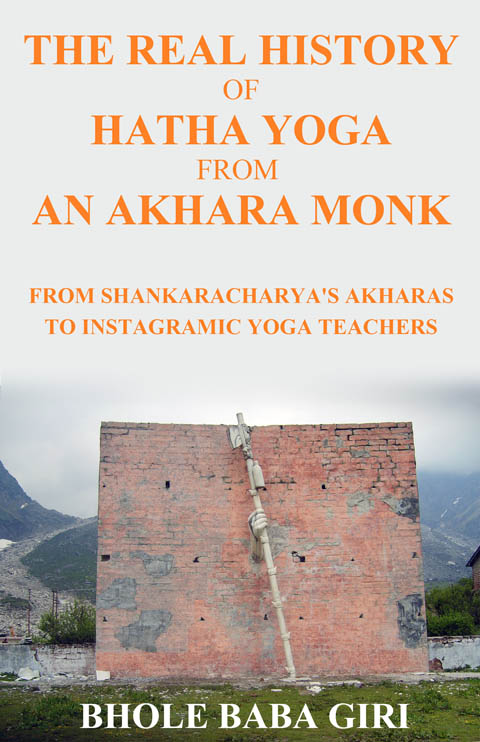
The Real History of Hatha Yoga from an Akhara Monk:
From Shankaracharya's akharas to instagramic yoga teachers
|
|
In the mass consciousness, hatha yoga is perceived as an ancient Indian teaching that supposedly allows one to reach spiritual heights through physical exercises. This book shows that this teaching is neither ancient, nor spiritual, and not even entirely Indian. Hatha yoga is based on the exercises of Indian wrestlers and Western bodybuilding, and it was created for quite pragmatic purposes – as calisthenics for combat akharas. In the 20th century, it was reformed in the wake of the Indian national liberation movement, and in this form, hatha yoga came to the West.
Contents
INTRODUCTION I
CHAPTER 1. SHANKARACHARYA'S AKHARAS AND THE FORERUNNERS OF THE MAIN TEXTS OF HATHA YOGA 1
CHAPTER 2. THE EMERGENCE OF THE MAIN TEXTS OF HATHA YOGA IN THE CONTEXT OF THE ACTIVITY OF THE AKHARAS DURING THE VIJAYANAGARA EMPIRE AND THE EAST INDIA COMPANY 13
THE CONTRADICTION OF YOGIC AHIMSA AND FIGHTING "MONKS" 21
CHAPTER 3. THE OBLIVION OF HATHA YOGA FOR A CENTURY AND A HALF AFTER THE BAN ON MARTIAL AKHARAS BY THE BRITISH COLONIAL ADMINISTRATION, AND ITS TRANSFORMATION INTO A STREET CIRCUS SHOW 23
CHAPTER 4. THE REVIVAL OF HATHA YOGA DURING THE INDIAN NATIONAL LIBERATION MOVEMENT 27
SRI TIRUMALAI KRISHNAMACHARYA 31
CHAPTER 5. THE BAN OF KRISHNAMACHARYA'S SCHOOL OF HATHA YOGA BY THE MINISTER OF INDEPENDENT INDIA AND THE TRANSFORMATION OF ASANAS INTO A FASHIONABLE FITNESS TREND ON THE WAVE OF THE HIPPIE REVOLUTION 43
PATTABHI JOIS 45
B. K. S. IYENGAR 54
T. K. V. DESIKACHAR 56
THE BEGINNING OF THE EMERGENCE OF MASS YOGABIZ IN THE LATE 20TH CENTURY 58
THE LOTUS POSE – A CARGO CULT BORROWED FROM BEGGARLY WANDERING SADHUS 66
YOGABIZ AND GLAMOROUS INSTAGRAM YOGA TEACHERS 72
TRAUMATISM OF POSTURAL YOGABIZ 75
GENERAL CONCLUSION 77
ABOUT THE BOOK 78
ABOUT THE AUTHOR 79
Introduction to the book
The purely spiritual achievements of the man devoted to yoga, or yogin, present no features of interest to the gazer or the tourist photographer. On the other hand, the more obvious outward manifestations of yoga-practice are so striking and often so sensational, that they have attracted the notice of the casual observer, from the days of Alexander even to our own.
Charles Rockwell Lanman,
"Indian Ascetics and Their Powers", 1917, p. 136;
"Transactions and Proceedings of
the American Philological Association", v. 48: 133-51
This book presents an unbiased view of the history and essence of hatha yoga from a Ukrainian who in 2004 received individual sannyasa diksha from Somnath Giriji, Mahamandaleshwar of the Sri Panch Dashnam Juna akhara in his main Himalayan ashram, has been given the name Bhole Baba Giri, and thus became a full-fledged member of one of the oldest Hindu akharas. Over more than 30 years of studying Hinduism and yoga, including more than 7 years of living in India itself, I have encountered conflicting views on the reasons for the emergence of hatha yoga and its actual goals, as well as different attitudes towards it from both Westerners and Hindus themselves.
The book presents an overview of the entire history of hatha yoga from the time of the appearance of Shankaracharya's martial akharas and the first texts with physical exercises, several centuries later attributed to hatha yoga during the formation and formalization of this teaching in the era of the Vijayanagara Empire, and to modern yoga teachers with their gymnastic courses of supposedly "that very ancient Indian mystical yoga" and glamorous instagrammers.
Nowadays, hatha yoga is stereotypically perceived by the majority as a supposedly necessary step on the path to the practice of yogic samadhi. But, looking at the millions of people who have been practicing supposedly ancient Indian spiritual practices for half a century under the guidance of professional yoga teachers and other representatives of yogabiz, one involuntarily asks oneself: where in this boundless stream of gymnasts are the new holy siddha yogis of the level of Lahiri Mahasaya and Sri Yukteswar?
Why, even in this very small line of succession from Babaji, both of these disciples one after another achieved holiness and demonstrated miracles, while among the millions of hatha yogis over the last hundred years of well-documented history, starting at least with Krishnamacharya, this "forefather" of all current postural yoga, there is not and has never been anyone who has achieved the goal of that very ancient Indian teaching of yoga?
Moreover, it was precisely the worldwide spread of hatha yoga that surprisingly coincided in time with the almost complete cessation of the emergence of new holy siddha yogis.
The fact is that the teachings of such yogis as Patanjali and Buddha set as their goal the achievement of yogarealization / buddha consciousness / superconsciousness / holiness through the practice of samadhi/shamatha meditation – not the ability to put one's leg behind one's head as a result of curvature and damage to the joints, not the scholastic subtleties of interpreting the teachings of Hindu Advaita or Buddhist "emptiness" and the endless theoretical discussions about them in monastic centers that have become an end in themselves, but namely the practical achievement of superconsciousness with the superpowers-siddhis that inevitably accompany it.
If someone, having decided to pump up their muscles, instead of regularly performing strength exercises, started buying pictures of bodybuilders, reading their books, watching their performances for years and going on excursions to places associated with famous bodybuilders, then the ineffectiveness of such an approach would be obvious.
However, this methodological error is very common in relation to samadhi meditation – this rather simple psychotechnics, which gives a result in the form of energy boosting only as a result of its practice with the proper quality, the correct duration of sessions and their regularity.
In this sense, invisible meditation is very similar to fitness, but it manifests itself at the level of consciousness and improves only as a result of the correct mental (not physical) efforts of the meditator himself.
For both Patanjali and Buddha, the key part of their teachings is the psychotechnics of samadhi/shamatha meditation. This is the last eighth part of both Patanjali's eight-fold yoga and the Noble Eightfold Path of Buddhism.
Neither Patanjali nor Buddha have a teaching on asanas. The word "asana" is mentioned in the "bible" of yoga – the "Yoga Sutras" – once (not counting the list in sutra 2.29), and in the context of meditation practice: "Asana ("sitting posture") should be stable and comfortable (sthira-sukham āsanam)". It is used in the "Yoga Sutras" in the singular and etymologically means only a "sitting pose" in the context of meditation practice, and not sophisticated gymnastic complexes of hundreds of physical exercises, most of which are non-sitting, and the vast majority of which are also uncomfortable and unstable, which clearly contradicts the description of asana (that is, a "sitting pose" for meditation practice) in sutra 2.46 of Patanjali's "Yoga Sutras". Moreover, according to the Ukrainian Indologist A. G. Safronov, this sutra 2.46 (sthira-sukham āsanam) was added to the "Yoga Sutras" later from the text of the classical Sankhya "Sankhya-prakashika-sutra" (aka "Sankhya-darshana" 3.34 by Kapila, or 22.12 in the alternative version here), in which this line quite clearly indicates that asana is not some kind of complex pose, but mere (any) comfortable stable sitting pose in which one can sit down to meditate.
In the Sanskrit text of the "Yoga Sutras", the word "asana" is mentioned in the singular ("asanam", āsanam) and is formed from the root "ās" – "to sit" (āsa) – by adding the suffix -ana, which gives the original meaning the sense of action (that is, asana is "sitting", or a sitting position). Patanjali does not say a word about the postural practices of hatha – only later commentators and copyists of commentaries succeeded in this. Asana in Patanjali is just an indication that for the practice of meditation it is necessary to adopt a sitting position. There is no variety of asanas and certainly no hatha yoga in Patanjali – all this will appear only about one and a half thousand years later, and for other purposes. In this sense, the phrase "standing asana" is an oxymoron, which arose after numerous modifications of the original meaning of the word in the context of various historical and political changes in the territory of Hindustan. The same applies to other asanas in which the yogi does not assume a sitting position.
In the history of hatha yoga with its steady exaltation of the role of asanas and their dominance in this Oriental version of fitness against the background of actual neglect of the very practice of "chitta-vritti-nirodha" (taming the disturbances on the mirror of the mind), 5 main stages can be distinguished.
The first stage is associated with the formation by Shankaracharya at the beginning of the 9th century of combat units in the form of Hindu monastic (or rather quasi-monastic, since they consisted mainly of astra-dhari - "weapon bearers") orders-akharas for the physical capture of Buddhist monasteries and the displacement of Buddhists from the territory of Hindustan. The main texts of hatha yoga, which will appear later, are somehow connected with these akharas.
The second stage in the history of hatha yoga took place in the 15th-18th centuries, and two periods can be distinguished in it. The first refers to the Vijayanagara Empire during its armed struggle with the northern Muslim sultanate in the 15th-17th centuries. The second period refers to the activities of the British East India Company on the territory of Hindustan, which actively used local armed monastic detachments-PMCs (private military companies) in its interests until the end of the 18th century. Most of the famous texts of hatha yoga were actually written at this stage.
The third stage was due to the ban on private armed formations introduced by the British administration in 1773, when the practice of asanas from the strength calisthenics (when only the weight of the body itself is used as a load, for example, plank exercise) training of PMC detachments of akharas for a century and a half turned into an extravagant show of street circus performers and beggars.
The fourth stage is associated with the strengthening of the national liberation movement in India in the second quarter of the 20th century, when the cult of physical strength and agility again became relevant for the Indians, this time in the fight against British rule. A prominent representative of this stage was Raghavendra Swami (1890-1996), also known as Tiruka ("beggar"), who popularized calisthenics under the guise of hatha yoga. It was at the beginning of this stage in 1928 that a gymnastic complex was invented, to which its inventor, an Indian raja, gave the name with a veiled meaning "Surya namaskar" ("sun salutation").
It should be noted that in India at that time, asanas were so strongly associated with the secretive training of Indian partisans, and not with some kind of spirituality that today's yoga teachers try to attribute to these banal gymnastic exercises, that immediately after India gained independence, even the yogashala (yoga school) of Krishnamacharya himself – the "forefather" of postural yoga – in Mysore was ordered to be closed by Kyasamballi Chengalaraya Reddy (who had been a revolutionary since childhood and a participant in protests against British rule in India), the first Chief Minister (from 1947 to 1952) of the Mysore State (now Karnataka State) of independent India, and in 1950 the school was closed.
The fifth stage, unlike the first two and the fourth, turned out to be connected with yogabiz, and not with martial themes, being an actual continuation and development of the third stage, when hatha yoga made another turn in its history. Preparations for its appearance began back in the 1930s with the formation by Krishnamacharya of various sequences of asanas for the show programs of his students in front of the Maharaja of Mysore and his bored guests, and in the 1960s slightly modified sets of these gymnastic exercises, which were a fusion of the first few asanas of hatha yoga, Indian wrestling, various systems of Western physical education and bodybuilding, came to the West as a result of the training of foreigners by Krishnamacharya's students. This stage continues to this day.
While hatha yoga exercises can strengthen muscle tone, although in this sense they are merely an amateur alternative to physiologically correct therapeutic exercise or sports training, they nevertheless have two inevitable problems.
The first problem with hatha yoga exercises is the vain promises of yoga teachers of the possibility of achieving yoga samadhi – which today's yoga teachers even call by the new-fangled term "hatha yoga samadhi" – with asanas alone (and other hatha yoga methods), or at least a significant easing of entry into this specific state of mind. This lie becomes obvious when studying the history of yoga – both postural hatha and the yoga of Patanjali itself – the psychotechnique of samadhi meditation, the essence of which is conveyed by the phrase "chitta-vritti-nirodha". In the entire centuries-long history of hatha yoga, there is not and never was anyone who has achieved superconsciousness / holiness by adopting certain body positions. I repeat, not a single such case. For example, Gorakhnath, to whom about 20 texts of yoga and hatha yoga are currently attributed, was actually a master of meditation. At the same time, most hatha yoga methods, including the absolute majority of asanas, were actually first proposed at least several centuries after his passing away.
In other words, all sorts of promises of yoga teachers are a kind of those who sell "successful success" in books and in stadium lectures, and also promise to teach how to master the power of the current moment simply at will without applying the necessary mental efforts, that is, without practicing samadhi/shamatha with the necessary quality, duration and regularity.
This problem nullifies the whole point of practicing hatha yoga, if the practitioner strives to achieve the goal of authentic ancient Indian yoga, that is, the yoga of Patanjali, which consists in achieving superconsciousness with the superpowers-siddhis that inevitably accompany it.
The second problem with hatha yoga exercises is the danger to physical health of many of its methods, and first of all this applies to many well-known asanas. More than 90% of all modern hatha yoga was invented in the 20th century by Krishnamacharya and his two followers – his brother-in-law B.K.S. Iyengar, who studied with him for no more than two weeks, and his fellow villager Pattabhi Jois, about whom Iyengar said that "Jois never attended Krishnamacharya's classes on a regular basis". Moreover, according to Jois, it was he who taught Iyengar, not Krishnamacharya.
None of these three had any medical or anatomical education in the decades when they developed their hatha yoga methods, nor did they have any diploma of special or higher education at all.
Subsequently, simple sets of physical exercises under the guise of supposedly ancient Indian yoga with its promising miraculous results (though having nothing to do with this gymnastics) successfully fell into the consciousness of the hippies of the 1960s, turning over the last half century in the West into a huge developing business, in which one of the main achievements, in addition to commercial success itself, has become bragging about glamorous asanas on Instagram and YouTube. At the same time, a road roller of ruthless postural yogabiz with its deceptive advertising of "that very wonderful ancient Indian yoga", exploiting this spiritual brand for free, has already displaced from the mass consciousness the idea of yoga as "chitta-vritti-nirodha" ("taming the disturbances on the mirror of the mind") – an idea that remained dominant in the territory of Hindustan for the last several thousand years.
The full text of the book is available here:
In English: https://www.amazon.com/dp/B0FGD4MQ1F
Auf Deutsch: Die wahre Geschichte des Hatha-Yoga von einem Akhara-Mönch: Von Shankaracharya-Akharas zu Instagram-Yogalehrern https://www.amazon.de/dp/B0FMZTSRGJ
In italiano: La vera storia dell'hatha yoga raccontata da un monaco akhara: Dagli akhara di Shankaracharya agli insegnanti di yoga di Instagram https://www.amazon.it/dp/B0FLF7HCTN
En español: La historia real del hatha yoga de un monje akhara: Desde los akharas de Shankaracharya hasta los profesores de yoga instagrameables https://www.amazon.es/dp/B0FK5WD8VS
日本語で: アカラ僧侶によるハタヨガの本当の歴史: シャンカラチャリアのアカーラからインスタグラムのヨガ教師まで https://www.amazon.co.jp/dp/B0FTXR26T1
In Russian: Реальная история хатха-йоги от монаха акхары: От акхар Шанкарачарьи до инстаграмных йогатичеров https://www.patreon.com/posts/133320885
|
|