|
You are on the page: Scriptures.ru ➤ Books ➤ Obstacles and myths in yoga and Buddhism
|
Vasyl Vernyhora
Obstacles, myths and cargo cults
in the practices of yoga and Buddhism
|
|
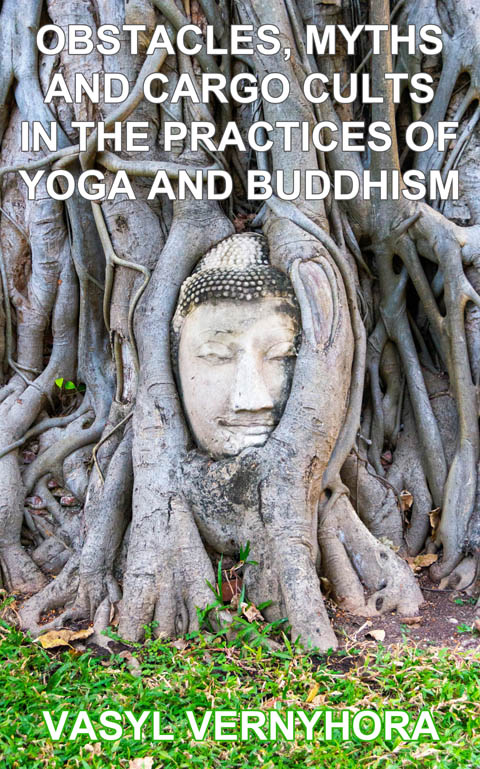
This book provides a detailed explanation of the layers of myths, cargo cults, obstacles and pitfalls that have accumulated on top of the teachings of Patanjali and Buddha in modern yoga and Buddhism.
In the popular consciousness, yoga and Buddhism are perceived as ancient Indian teachings, supposedly preserved unchanged since the time of Patanjali and the Buddha. However, careful historical, linguistic and comparative analysis reveals that these teachings have been significantly altered and distorted by generations of followers, both in their oral and written transmission. The purpose of this book is to help the reader avoid dead-end approaches by revealing the obstacles, pitfalls, myths, and cargo cults that have accumulated over millennia on top of the teachings of Patanjali and the Buddha. This will give the reader the opportunity to move on to the practice of truly efficient methods for developing the supramental structures of superconsciousness, which is the goal of the teachings of these holy figures.
Contents
Introduction 1
1. Obstacles in the practice of meditation 3
1.1. Excessive preoccupation with theory to the detriment of actual practice 3
1.2. Long-term practice of "preparatory" asana gymnastics instead of actual meditation practice 5
1.3. Destruction of the most ancient texts of the teachings of Buddha and Padmasambhava by the leaders of the new Buddhist schools. 11
1.4. Distortion of the practical teachings of Patanjali, Buddha, Jesus and other saints during their transmission by generations of theoreticians. 16
Patanjali's yoga and modern postural gymnastics 16
The teachings of Buddha and modern Buddhism 17
The teachings of Jesus and modern Christianity 19
2. Myths about meditation practice 21
2.1 Common misperceptions of drugs in the context of meditation 21
2.2 Kundalini yoga, holotropic breathwork and rebirthing 24
2.3. Using meditation to treat diseases 27
2.4. Guided meditations 29
2.5. Myths about meditation in the public consciousness and in the media 31
2.6. Attempts to use binaural beats and mind machines in a futile attempt to improve meditation in the long term 37
2.7. "Inert shamatha" 39
2.8 What meditation is not 44
2.9. The dissemination of distorted versions of the teachings of Patanjali and Buddha by those who claim arhatship and enlightenment without achieving the results inherent to that level 47
3. Cargo cults in yoga and Buddhism practices 55
3.1. Attempts to practice vipashyana before mastering shamatha 55
3.2. Postural practices performed in the vain hope of achieving a spiritual transformation of consciousness through gymnastic exercises 56
Ineffectiveness of hatha yoga in relation to the goals of Patanjali's yoga 57
Hatha yoga is a palliative substitute for Patanjali's yoga 59
The orthogonality of Patanjali's yoga to society 61
"Still, it's better this way than nothing at all!" 63
3.3 Advaita lecturers 64
Awareness of the concept of Advaita by saints 64
The degrees of attainment of superconsciousness vary. 65
Attempts to convey the concept of Advaita on a mental level 65
Advaita philosophy in particular and philosophizing in general at the level of the mind-manas 66
The creation of the Advaita teaching by Shankara for religious and political purposes - to displace Buddhism from Hindustan on a theoretical level 68
Shankara's creation of not only Advaita, but also quasi-monastic military akharas for the physical expulsion of Buddhists from Hindustan 69
Technology for achieving enlightenment 70
The illusion of achieving enlightenment 72
Advaita-"non-duality", or atritva-"non-triplicity"? 73
Two categories of Advaita lecturers 74
Cargo cult of "enlightened" Advaita lecturers 74
On the gradations of the levels of development of consciousness and superconsciousness 78
A tale of Advaita 80
3.4. Prayer wheel - cargo cult of Mahayana Buddhism 81
3.5. Theatrical religious rituals of Tibetan Buddhism, including those inherited from local shamanistic traditions 84
3.6. The practice of kasinas in Theravada for the purpose of achieving jhana and acquiring supernormal abilities-siddhis 87
Coloured kasinas are a legacy of Hindu temple customs. 89
3.7. Different understandings of metta in the Pali Canon and in modern Buddhism 92
General conclusion 94
About the author 96
Introduction to the book
The efficiency of progress along the path of yoga and Buddhism depends both on the correctness of the practiced methodology for the development of consciousness, taught by Patanjali and the Buddha, and on the avoidance of those obstacles, traps and cargo cults (external imitation of any process without using the proper methods for its implementation due to a lack of understanding of its essence) around meditation, which force the meditator to waste energy and time on activities that are in principle incapable of leading to the goal of the teachings of Patanjali and the Buddha - the development of superconsciousness.
If you turn down a dead-end path from the very beginning of your practice, you could spend your entire life pursuing various myths and cargo cults without achieving the desired results. Buddhism emphasizes the unique value of human birth, which offers the chance to attain enlightenment—that is, to develop the supramental structures of superconsciousness, or at least to advance along the path of its development.
At the same time, most people choose to achieve immediate results while living in the hectic cycle of samsara, neglecting any obscure spiritual teachings of self-development. In youth, it seems that their whole life is ahead of them, and that everything can be done and even redone many times over. But human life is a very limited resource of time and energy, which must be managed with the utmost awareness and wisdom.
This book will examine various obstacles, myths, and cargo cults in the practices of yoga and Buddhism that many people get stuck on, including most of those I interacted with in India and abroad, as well as the author of this book. Such distractions from the teachings of Patanjali (who, for example, never practiced hatha yoga with its asanas) and the Buddha (who, for example, never walked with a prayer wheel or meditated on single-color kasina circles) usually arose from a limited and simplified understanding of the teachings, gradually emasculated by followers. Or, this occurred for the sake of achieving certain worldly goals under the guise of supposedly spiritual teachings by certain authoritative religious figures.
In India, I studied Hindu yogic samadhi, as well as Buddhism, living in such Buddhist cities of India as Dharamsala, Bylakuppe, and in various places in Ladakh, including Lamayuru, Alchi, Leh, and others. Since 1997, I lived in India for more than seven years (from 2001 to 2006, without leaving India at all) and, perhaps the first in the CIS, received individual sannyasa diksha on May 19, 2004, from Somnath Giriji, mahamandaleshwar (one of the chairmen) of the Hindu monastic lineage of Sri Panch Dashnam Juna Akhara (Juna Akhara was once known as Datta Akhara and Bhairavi Akhara) at his Himalayan head ashram.
The full text of the book is available here:
In English: https://www.amazon.com/dp/B0FSQMBPW2
En español: Obstáculos, mitos y cultos cargo en las prácticas del yoga y el budismo https://www.amazon.com.mx/dp/B0FYZ8CQ5V
Auf Deutsch: Hindernisse, Mythen und Cargo-Kulte in der Praxis von Yoga und Buddhismus https://www.amazon.de/dp/B0FWXT2M7L
In Russian: Препятствия, мифы и карго-культы в практиках йоги и буддизма https://www.patreon.com/posts/139853887
|
|