|
You are on the page: Scriptures.ru ➤ Upanishads ➤
|
TRIPURA-TAPINI UPANISHAD
Atharvaveda
Shakta group of Upanishads
I praise the Supreme Truth, which is Absolute Knowledge and can be known through knowledge of the Tripura-tapini Upanishad.
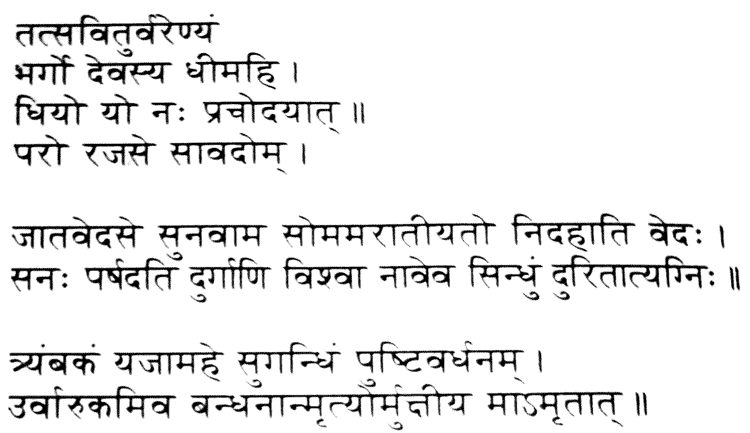
The Lord assumed the form of destructive power and spread Himself over all three worlds – bhuh, bhuvah and svah. He then possessed the power of Adi-Shakti, i.e., Adi-Shakti spread from His heart. This is the same Shakti that is called Shivamaya, and She can be perceived through Her fundamental syllable "hrim." The entire universe was covered by this Shakti. And since She encompassed the three worlds (Tripura), She came to be called Tripura. This Tripura-Shakti possesses the following vidya, called Sri-Vidya, which can be extracted from the following Vedic mantras:
This hundred-letter vidya in its entirety is the highest vidya. It is Parameshvari, Tripura Herself. The first four lines of the above mantras describe the glories of Parabrahman. The next couple of lines are associated with the greatness of Shakti. The last lines are the glories of Shiva Himself. This Vidya contains all the worlds, all the Vedas, all the Shastras, all the Puranas, and all the Dharmas, and it is the Radiance that arose from the fusion of Shiva and Shakti.
Now let us comment on the most important and hidden meanings of these verses. The great word "Tat" is used here to denote the Eternal Parabrahman Himself. This is the symbol used to denote the Lord who transcends all definitions and judgments. This Lord is the very embodiment of Supreme Knowledge, for He desires to exist in the form of Absolute Knowledge. He alone is the Great Lord Shiva, Whom the sages and yogis seek by performing Yajnas. Therefore, desire originates here.
Thus, the Lord, beyond the reach of all desires, still desires and is desired. He creates the alphabetical order of language. Therefore, the Lord is called Kama (Desire). The letter representing Kama is called "ko." Therefore, the word "Tat" represents the letter "ko." This is the meaning of the word "Tat." "Savituh" comes from the Sanskrit root "sunj praniprasave," which means the Originator (Creator of all beings). He is the Great Power. Power is Shakti. This Great Shakti, or Devi, called Tripura, is embodied in the Mahakundali (yantra). Similarly, one with intelligence can cognize the fireball (of the sun). This Shakti (power) of the trikona (triangle) gives birth to the letter called "e". Therefore, we must cognize the syllable "e" from the word "Savituh".
"Varenyam" denotes That which is to be adored and revered, Which is indestructible and worthy of all praise. It must be understood that from the word "varenyam" the syllable "i" is derived. A commentary on "bhargo" and "dhimahi" follows. The letter "dha" signifies dharana (concentration). "Dhi" (intellect, buddhi) is always concentrated on the Lord. "Bharga" is the Lord Himself, Who can be known only after attaining the fourth stage of avastha; He is the Being that permeates all existence. The letter representing this fourth stage is called "i," and this is the true meaning of the above words of the mantra. Now let us discuss the word "mahi." "Mahi" signifies greatness, inaction, strength, inflexibility, and all this refers to the element that possesses all these properties. The letter "la" represents earth. This is the highest state. Thus, this lakara (the syllable "la") indicates the Earth as containing all the oceans, forests, mountains, and seven islands. Therefore, the form of Devi called Earth is denoted by the elephant "mahi".
Now about "dhiyo yo nah prachodayat". Para (the Supreme) is the Imperishable Shiva, the Eternal Soul. The hidden meaning here is this: we should meditate on the motionless form of lakara (Jyotirlinga), or Lord Shiva, the Supreme of all that has ever existed. There is no desire for any dhyana here. It is above all dhyanas. Therefore, we approach the Lord with a request to stabilize our minds in that state of nirvikalpa, where thinking itself is completely absent. Such a request cannot be made with the mouth. It must simply be thought about.
Next comes "paro rajase savadom." After meditating on the image of the Supreme Truth, a powerful radiance appears, pure and blissful, full of knowledge that resides in the depths of the heart. This is the essence of all speech and knowledge. This is the true Shakti. And all this is called panchakshara, since it creates the five elements (pancha-bhuta). The intelligent should understand this correctly.
This is vidya, which grants the devotee the fulfillment of all desires. Thus, having understood this vidya of thirty-two letters in its true meaning, the devotee should think of the letter called "li," which is the form of Shiva, the Eternal, pure State. The letter resulting from the combination of the sun and moon, that is, the fusion of Shiva and Shakti, is "ha," and it is also called "hamsa." It is the seed of Kama. Through this Vidya, we can know the Supreme Lord Shiva. This combination can also be interpreted as the immersion of the jivatma in the Supreme Paramatman. Here, "la" denotes the Stage of Eternity or final Liberation. Such knowledge can be obtained from Sri Vidya. He who knows this becomes Rudra. He enters the abode of Vishnu and attains Parabrahman.
Now about the second mantra. This mantra glorifies the greatness of Goddess Tripura. By the word "jata" is meant Lord Shiva. He, who gave birth to the first letters of the varna-matrika in the form of bindupura omkara at the very beginning, is called "jata". Or we can also say that since He desired from the very beginning, being newly born, the fulfillment of His desire, He is called "jata". The knowledge of Goddess Tripura should be carefully studied in the same way by dividing the mantra into its constituent individual words (according to the mantra-shastra). Then one can get any protection from this mantra. The main thing to understand here is that "jata" is the One Lord, the Radiant Existence. This should be considered the foundation of any vidya related to Tripura. It is also important to understand that the letter "so" refers to the power of Shakti and the word "somam" refers to the state of Shiva. He who knows this becomes famous and influential.
Thus, this vidya, where Goddess Tripura eternally resides, should be considered the foundation of any vidya, and the devotee should always study and repeat this vidya. This vidya is the embodiment of the powers of Shiva and Shakti. This vidya is called a part of the Mother Sri Tripura Herself. The same vidya, when used for meditation, is called "sarvatodhira."
The Sri Vidya Chakra of Tripura is the Queen of all chakras. It grants the fulfillment of all desires and can be worshiped by everyone without any restrictions. This chakra is the gateway to moksha, and yogis, having broken through to Brahman with the help of this vidya, attain permanent bliss. This chakra is the home of the Goddess Tripura.
Now about the Mrityunjaya-anushtup-mantra. "Tryambakam" (trayanam ambakam) means "Lord of the three [worlds]". "Trayanam" means "of the three [worlds]", "ambakam" is the Lord of this. "Yajamahe" means "sevamahe" (to serve). Also, the word "mahe" means "Mrityunjaya" (Conqueror of death). Therefore, the word "yajamahe" is very important here.
The word "sugandhim" means "to be famous everywhere". The word "pushti-vardhanam" means "he who creates all worlds, maintains all worlds, permeates all worlds, and grants salvation to all worlds."
"Urvarukam" means "cucumber." "Urvarukamiva bandhanan mrityor-mukshya ma'mritat." The cucumber is, as it were, bound by the bonds of the stem. Similarly, humans and other beings are bound by the bonds of samsara. Here it means that from the bonds of maya, earthly beings are liberated for Eternal Bliss, just as a cucumber becomes free from the stem that held it.
One who wants to conquer death should repeat the mantra "Mrityunjayaya...". One who aspires to become Rudra should use the mantra "Om namah...". Then he will definitely derive the greatest benefit from it. There is another mantra, "tad vishnoh paramam padam...". Vishnu is the one who pervades the entire universe. His highest state, like the sky, is called "paramam padam". "Surayah" means the learners or those intelligent persons who have realized the Reality (Brahman) and so on. This highest state of Vishnu resides in each and every being. By "residence" we mean "vasati". Therefore He is called Vasudeva. The powerful twelve syllables of Sri Vasudeva's mantra "Om Namo Bhagavate Vasudevaya" constitute all that exists. They are sufficient for liberation from all sins. One who knows this mantra attains Brahma Purusha, the embodiment of the three letters "a," "u," and "m."
There is also the powerful mantra "Hamsa Shuchisat...". This is the great mantra of the Sun God. And another mantra known as "Gananam Tva...". This is the mantra of Ganapati. One who knows and recites these mantras of Shiva, Vishnu, Surya, and Ganapati will receive revelations directly from the Goddess Tripura.
Gayatri exists in four forms. In the morning, She is called Gayatri. At noon, She is Savitri. In the evening, She is Saraswati. She is always called ajapa when She has the fourth pada. This Goddess takes the form of the fifty letters of the alphabet from the letter "a" to the letter "ksha." In this form, the Goddess encompasses all shastras and all worlds. Again and again, worship Her.
Thus, every devotee who worships Goddess Tripura with these mantras becomes a true witness of Reality. Then he attains moksha. This should be properly understood by all. Now we will expound the karmakanda of worshiping Tripura. Shakti, or Adimaya, directs the Supreme Brahman. This Brahman is Absolute Knowledge, and It is called Paramatman. This Supreme Being is the Hearer, the Knower, the Seeer, the Commander, the Perceiver, and the Supreme Purusha, residing in the Atman of all beings. This should be known. There is neither world nor non-world, neither God nor non-God, neither existence nor non-existence, neither Brahman nor non-Brahman. This is the radiance of Nirvana, which is called Parabrahman.
The mind that reflects on something is called Baddha. One that does not reflect on anything is called Mukta. Only in this way can Brahman be understood. Therefore, one should ensure that the mind remains free from thoughts of various things. One should strive to control the Pranas until the mind is devoid of all thoughts. This is eternal knowledge. Everything else is nothing more than unnecessary descriptions. In Parabrahman, there is no difference between thinking and non-thinking. There, everything is one. There is nothing and no one to think about.
So, ultimately, the devotee must gradually realize that he himself is Brahman, and then he will attain blissful Liberation. Now the Supreme Truth is revealed. There is no one striving for Liberation, no one is liberated, no vairagya, no sadhana, no destruction. There are two Brahmans, namely shabda-brahman and Parabrahman. He who has subdued shabda-brahman attains Parabrahman. Having acquired the necessary knowledge from books, an intelligent person should discard these books, just as one who needs the very core of a grain discards the husk. Thus is the state of the Supreme Brahman described. He who possesses this great vidya will be revered by others. There is no doubt about it. Such is this great Upanishad.

