Oh! O devas, may our ears hear what is auspicious;
May our eyes see what is auspicious, O worthy of worship!
May we enjoy the life span allotted to the devas,
By steadfastly praising them with our bodies and limbs!
May the glorious Indra bless us!
May the omniscient Sun bless us!
May Garuda, the thunderstorm of the evil and wicked, bless us!
May Brihaspati grant us prosperity and good fortune!
Om! Let there be peace in me!
Let there be peace in my surroundings!
Let there be peace in the forces that act upon me!
1. OM. Then Paippalada ("the partaker of the fruit of action") addressed Brahma. "[If we choose] among Brahma, Vishnu and Rudra, O Lord, upon whom should we meditate most? Kindly tell us this truth."
2. The great progenitor ("pitamaha", i.e. Brahma) replied to him: "O Paippalada, listen to this."
3. Parameshvara (the Supreme Lord) is attained by one who has acquired much merit. I myself, Hari, Indra and others are born from His body.
4. The Devas and others do not know, due to their ignorance, the great Lord, who is the Supreme Ishvara, and the Father.
5. He who in the beginning created Brahma, and gave Him all the Vedas, is to be praised, who is the divine Lord, the Father of the Devas and the Creator of Me (i.e. Brahma) and Vishnu.
6. He is the Supreme, who dissolves all the worlds at the time of dissolution. He is the only ruler of all.
7. He, the Supreme Lord, who assumes the terrible form called "Sharabha" (a combination of divine bird, lion and man), the powerful one, killed (was about to kill) Nrisimha (Narasimha), the destroyer of the world (when Nrisimha drank the blood of Hiranyakashipu, He became painfully ill, as He could not digest it). The lords of the devas requested Him (Sharabha), who was about to take His (Nrisimha's) life, at His feet: "No, O powerful one, do not take the life of Vishnu, O You, on this dark night."
8. The Lord with his sharp claws performed bloodletting (of the body of Nrisimha, filled with the poisonous blood he had drunk) out of compassion, and that powerful one, who had donned the skin of Nrisimha, is called the great hero Virabhadra ("the pacifier of the heated").
9. He, Rudra, alone should be meditated upon for all worldly blessings and spiritual attainments, even to the attainment of freedom-independence ('svatantra').
10. Praise that Rudra, the destroyer of the fifth (lying) face of Brahma.
11. Praise that Rudra, who with a fiery spark flying from His forehead reduces all worlds to ashes, again creates and preserves them, thus revealing His independence.
12. Praise that Rudra, who with His left foot destroyed death (the story of Markandeya), and who drank the terrible poison.
13. Praise that Rudra who bestowed the discus (chakra) upon Vishnu, who worshipped Him with one of his eyes on his left foot (when Vishnu found that one lotus flower was missing, He plucked out one of his eyes while making an offering and completed the sahasranamarchana – worship of a thousand names).
14. Praise that Rudra who, powerful, at the sacrifice of Daksha, after subduing many devas (deities), bound Vishnu with a great noose.
15. Praise that Rudra who, as if in play, burnt away the three terrible cities; who has the sun, moon and fire as his three eyes; to whom all the devas became servants (pashus), and who for that reason assumed the name ‘Pashupati’ (the Lord of all the pashus, the ignorant jiva-souls).
16. Thus praising Him in various ways, [the Devas] pacified Nilakantha (the "blue-throated" Shiva), the great Lord.
17-18. Praise that Rudra who, the ancient Lord, destroyed the terrible and troublesome incarnations of Vishnu named Matsya, Karma, Varaha, Narasimha and Vamana; and who reduced to ashes Manmata (the god of love). Thus with many hymns [the Devas] pacified Nilakantha, the great Lord.
19. He, Parameshvara, removes all kinds of suffering, birth, death, etc., caused by the three kinds of attachments. Thus praised by hymns, the ancient Lord, the essence of all embodied beings, Shankara, protects all beings. He must be praised, transcendent of mind and speech, the great Lord, whose two lotus-like feet Vishnu even now longs to find. The Lord showed His mercy to Vishnu, who bowed down with great devotion.
20. Realizing the bliss of Brahman, from which speech returns with the mind, without reaching Him, the realizer never experiences fear.
21. He is subtler than the subtlest and greater than the greatest – the Atman is hidden in the innermost depths of this being. By His grace he who has no desires and regrets beholds His glory.
22. Vasishtha, Vyasa, Vamadeva, Virinchi and others meditate on Him in their hearts; the ancient Lord, Mahesha, praised by Sanatsujata, Sanatana and others. He is the truth, the eternal, the witness of all, Mahesha (the Great Lord), ever blissful, formless, with unlimited energy, and who has no Lord above Him, by His own (sva) illusion (avidya; imagination; unknown [hitherto]) created (kalpita) by His own will (maana) the manifested world (bhuumi).
23. Overwhelmed (ati) by delusion (moha) due to the influence (kariya) of maya (maayaa) are the Self (mama, i.e. Brahma) and Vishnu, O strict in observing vows (suvrata). By meditation (dhyaana) on His lotus feet (paada-ambuja), the difficult (dustaraa) (maya) is easily overcome (sutaraa).
24. Vishnu, the source of all worlds, with his manifestations, and also with My manifestations, maintains all worlds. They dissolve when their time comes. Therefore (except Him, i.e. Shiva) all others are false (mrishaa).
25. Om! Praise that Rudra (rudraaya-namo-astu), the great Devourer [of everything] (mahaa-graasaaya), the great Lord (mahaa-devaaya), holding a trident (lit. "shuuline" – holding a spear or its varieties; trident – "trishuula"), Maheshvara, the merciful (sparing).
26. The Omnipresent (Vishnu) is a great Being. There are many other beings. The Eternal (Shiva) is one; being the essence of all, He enjoys all, pervades all the three worlds.
27. You are invoked ('huuya') with the mantra of four syllables twice, with the two syllables, and of course ('eva'), with the mantra of five ('panchami') syllables ('namah Shivaya'), and again with the purificatory two syllable mantra. Omnipresent, be propitiated by me.
28. The offering is Brahman, the libation is Brahman, sacrificed by Brahman on the fire of Brahman, and he must attain Brahman, focused on the deed for the sake of Brahman (this verse in Sanskrit is completely analogous to the verse Bhagavad-gita 4.24).
29. (Definition of Sharabha.) The Sharas (shara) are the jivas. They always shine (bha) in His body. Therefore the all-consuming Brahman is called Sharabha. O great sage, who directly gives salvation (moksha).
30. The Devas (deities) are deluded by the influence of His maya through the ideas of "mine", etc.
31. It is impossible to describe His glory, even a fraction of it.
32. Brahma is higher (this world); higher than Him is Vishnu; higher than Him, verily, is Isha (Mahesha). There is none equal to or higher than Him.
33. There is only one Shiva, the eternal. Everything else except Him is false. Therefore, having given up the worship of all other gods, one should always meditate only on Shiva, the remover of all samsaras (the cycle of birth and death).
34. Praise to Him, the great Devourer, Maheshvara.
35. This great teaching (maha-syastra), O Paippalada (paippalada), should not be imparted to anyone and everyone, to an atheist, to an ungrateful person, to one of bad character, to the malicious, to an egoist, to a sinner, to a cheat, to a liar. It should be imparted to a pleasant speaker, to a devotee who observes good vows, to one of good conduct, to a devoted guru, to one who is calm and peaceful, to one who is kind-hearted and devoted to Shiva. This teaching of Brahman can be imparted through one who has the above-mentioned qualities. It should be taught only to one's own disciples who do not break good vows, O sage, and should not be imparted to others. It should be kept secret always, O best of the Brahmins.
36. A twice-born person who studies and hears this teaching of Paippalada becomes freed from birth and death. He who realizes it attains the state of immortality. He becomes free from the womb; he becomes purified from the sins of drinking alcohol, stealing gold, killing a Brahmin, committing adultery with the wife of the guru. He acquires the merit of studying all the Vedas and meditating on all the Devas (deities); he becomes purified from all heinous crimes; he acquires the merit of going to Kashi (Varanasi). Shiva will always (satata) be favourable (priya) to him. He attains the same state as Shiva (siva-saayujya). He never returns to this world, never returns to this world (punaraavartate-na). He becomes Brahman itself. Thus speaks the Lord (bhagavaan) Brahma. Thus ends the Upanishad. Om.
Om! O devas, may our ears hear what is auspicious;
May our eyes see what is auspicious, O worthy of worship!
May we enjoy the life span allotted to the devas,
By steadfastly praising them with our bodies and limbs!
May the glorious Indra bless us!
May the omniscient Sun bless us!
May Garuda, the thunderstorm of the evil and wicked, bless us!
May Brihaspati grant us prosperity and good fortune!
Om! Let there be peace in me!
Let there be peace in my surroundings!
Let there be peace in the forces that act upon me!
Shakti sources say that after the meeting of Sharabha and Narasimha, Pratyangira (a formidable form of Devi) appeared and pacified Sharabha.
Discussion of the Sharabha Upanishad with an alternative abridged version of the translation here.
Sharabha ('sharabha' is a type of deer in Sanskrit) is an eight-legged mythical animal in Indian mythology, said to live in the Himalayas. It is also called utpadaka and kunjararati. Detailed article in English about Sharabha.
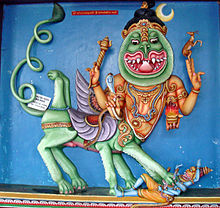 7. He, the Supreme Lord, who assumes the terrible form called "Sharabha" (a combination of divine bird, lion and man), the powerful one, killed (was about to kill) Nrisimha (Narasimha), the destroyer of the world (when Nrisimha drank the blood of Hiranyakashipu, He became painfully ill, as He could not digest it). The lords of the devas requested Him (Sharabha), who was about to take His (Nrisimha's) life, at His feet: "No, O powerful one, do not take the life of Vishnu, O You, on this dark night."


