
|
You are on the page: Scriptures.ru ➤ Upanishads ➤
|
SHANDILYA UPANISHAD
Atharvaveda,
upanishad group - yoga
Om! O devas, let our ears hear what is auspicious;
May our eyes see what is auspicious, O ye worthy of worship!
May we enjoy the life span allotted by the devas,
Praising them unwaveringly with our bodies and limbs!
May the glorious Indra bless us!
May the omniscient Sun bless us!
May Garuda, the thunderstorm of the evil and wicked, bless us!
May Brihaspati grant us prosperity and good fortune!
Om! Let peace be in me!
May peace be in my surroundings!
Let peace be in those forces that act upon me!
CHAPTER I
1. Shandilya asked Atharvan this question: "Please tell me about the eight angas (steps) of yoga, which is the means of attaining Atman."
Atharvan replied: "The eight anga of yoga are yama, niyama, asana, pranayama, pratyahara, dharana, dhyana and samadhi. Yama is in turn divided into ten parts; so is niyama. There are eight asanas. Pranayama is of three kinds; pratyahara is of five kinds; dharana is of the same number. Dhyana is of two kinds, and samadhi is of only one kind.
Yama (forbearance) is of ten kinds: ahimsa, satya, asteya, brahmacharya, daya, arjava, kshama, dhriti, mitahara and saucha. Ahimsa is the non-causing of any pain to any being at any time through the actions of one's mind, speech and body. Satya is the utterance of truthful words which promotes the welfare of beings through the activities of the mind, speech and body. Asteya is the absence of the desire to steal another's property in the actions of the mind, speech and body. Brahmacharya is abstinence from sex in all situations and in all states in the actions of the mind, speech and body. Daya is kindness towards all beings in all situations. Arjava is maintaining equanimity of mind, speech and body while performing or not performing respectively prescribed or prohibited actions. Kshama is a patient attitude towards all pleasant and unpleasant things, such as praise or blame. Dhriti is maintaining steadfastness of mind during the acquisition or loss of wealth or relatives. Mitahara is eating oily and sweet foods and leaving the stomach unfilled by one-fourth. Saucha is of two types – external and internal. External is purification of the body with earth and water; internal is purification of the mind. The latter (i.e. the internal shaucha) should be achieved through adhyatma-vidya (the science of the higher Self).
2. Niyama (monastic precepts) is divided into ten types: tapas, santosha, astikya, dana, ishvarapujana, siddhanta-shravana, hrikh, mati, japa and vrata. Tapas is the liberation of the body through the observance of penances such as krichchra, chandrayana, etc., according to the rules. Santosha is contentment with everything that happens to us and comes to us without any effort on our part. Astikya is faith in the merits and demerits of actions as stated in the Vedas. Dana is the faithful donation of lawfully acquired money, grains, etc. to worthy persons. Isvarapujana is the worship of Vishnu, Rudra, etc. with a pure mind according to one's capacity. Siddhanta-sravana is the study and analysis of the meaning of Vedanta. Hrih is modesty and decency, and the shame felt in doing anything contrary to the rules of the Vedas and society. Mati is faith in the lines of conduct laid down in the Vedas. Japa is the repetition of mantras into which one is properly initiated by his spiritual master, and which does not contradict the rules of the Vedas. Japa is of two kinds – with oral and mental pronunciation. Mental japa pertains to contemplation with the mind. Oral japa is of two kinds – with loud and silent pronunciation. Loud pronunciation brings merit according to the statement [in the Vedas]; [while] silent [brings] merit a thousand times [greater]. Mental [japa brings] merit ten million (crore) times [greater]. Vrata – regular observance of the actions prescribed in the Vedas and abstinence from the prohibited ones.
3. There are eight [basic] asanas (body positions) - swastika, gomukha, padma (lotus), vira, simha, bhadra, mukta and mayura. Swastika is a sitting position with the back erect and without strain, with each foot placed between the thighs and knees of the other.
4. Gomukha is [a sitting position with the spine erect and relaxed] and placing the sole of the left foot under the right buttock and the sole of the right foot under the left buttock, which resembles gomukha (the face of a cow).
5. Padma (lotus) is [the sitting posture with the back erect and relaxed] and placing the sole of each foot on the thigh of the other leg; the right hand holding the toe of the right leg and the left hand holding the toe of the left leg. This posture, O Sandilya, is praised by all.
6. Vira is [a sitting position with the back erect and without tension] and placing one foot on the thigh of the other leg and the other foot under the corresponding [opposite thigh].
7-8. Simha is [a sitting position with the spine erect and relaxed] and pressing the sole of the left heel to the right side [of the thigh] and vice versa. Place your hands on your knees, extend your fingers forward, open your mouth and consciously fix your gaze on the tip of your nose. This asana is always praised by yogis.
9. Siddha is [a sitting position with the back erect and without tension] and pressing the left heel to the perineum and placing the heel of the right foot above the genitals with concentration of the mind on the spot between the two eyebrows.
10. Bhadra is [a sitting position with the back erect and without strain] and firmly pressing the ankles of both feet against each other against the lower part of the genitals and firmly grasping the knees with the hands. This is bhadra, which destroys all diseases and poisons.
11. Mukta is [a sitting position with the back erect and without tension] and pressing the left heel to the right side of the lower part of the genitals and vice versa.
12-13. Mayura (literally "peacock") is a horizontal position of the body on the hands, when the palms rest on the ground, the elbows rest on the stomach on the sides of the navel, the head and legs are raised and do not touch the ground. This is a pose called mayura, which destroys all sins.
14. By these postures all diseases within the body are destroyed; all poisons are removed. Let a person who is unable to practice all these postures devote himself to the practice of any [of them] which he finds easy and pleasant. He who masters these postures masters the three worlds. He who practices yama and niyama should practice pranayama; by this the nadis (subtle channels of the body) will become purified."
15. Then Shandilya asked Atharvan this question: "How are the nadis purified? How many are they? How do they arise? What vayus (vital airs) are in them? Where are they? What are their functions? Please tell me everything that should be known about the body." In answer to this question, Atharvan said the following: "The length of this body is ninety-six digits (1 finger = 3/4 inch = 1.9 cm). Prana extends twelve digits beyond the body. He who, through the practice of yoga, shortens his prana within his body, making it equal to or not less than the fire in it, becomes the greatest of yogis. In humans, the region of fire, which has the shape of a triangle and shines like molten gold, is located in the middle of the body. In animals with four legs, this region (fire) has the shape of a quadrangle. In birds, it has the shape of a ball. In the region of this vital center is the purifying, beneficial subtle flame. Two digits above the anus and two digits below the penis is the center of the body in men. In animals with four legs, it is in the middle of the heart. In birds, it is in the middle of the body. Nine digits from (or above) the center of the body is an oval shape occupying four fingers in length and breadth. In its middle is the navel. In it is located the chakra (disc) with twelve spokes. In the middle of the chakra wanders the jiva (Atman), guided by its good and bad deeds. As a spider rushes to and fro within the web of fine threads, so does the prana move here. In this body, the jiva moves on the prana. The seat of the kundalini is in the middle of the navel and above it. Kundalini-shakti has the form of eight prakriti (matters), and it is coiled eight times. The movement of the vayu (vital airs) properly checks the food and drink all around the skandha. She closes with her head (the opening) brahmarandhra and during (the practice of) yoga it is awakened by fire (in apana); then it shines with great splendor in akasha of the heart in the form of wisdom. There are fourteen principal nadis conditioned by kundalini situated in the centre. Their names are ida, pingala, sushumna, saraswati, varuni, pusha, hastijihva, yashasvini, visvodhari, kuhuh, sankhini, payasvini, alambusa and gandhari. Of these, sushumna is considered to be the support of the universe and the path to salvation. Situated at the back of the anus, it is connected with the spine and extends to the brahmarandhra of the head, being invisible, subtle and vaishnava (or of the shakti nature of Vishnu). To the left of sushumna is ida and to the right is pingala. The moon moves in ida and the sun in pingala. The moon is of tamas nature and the sun is of rajas nature. The poison aspect is associated with the sun and the nectar aspect with the moon. They both direct (or indicate) time and sushumna enjoys (or absorbs) time. Behind and near sushumna are saraswati and kuhuh respectively. Between yashasvini and kuhuh is varuni. Between pusha and saraswati is payasvini. Between gandhari and saraswati is yashasvini. In the center of the navel is alambusa. In front of sushumna is kuhuh, which extends the length of the genital organ. Above and below kundalini is varuni, which extends everywhere. yashasvini, which is beautiful (or relates to the moon), reaches to the big toes. Pingala goes upward to the right nostril. Payasvini goes to the right ear. Saraswati goes to the top of the tongue, and Shankhini to the left ear, [while] Gandhari starts behind ida and goes to the left eye. Alambusa goes upward and downward from the root of the anus. From these fourteen nadis extend others (the minor nadis); from these, in turn, extend other nadis, and from these, in turn, the rest; thus it should be known. As the leaf of the ashvattha tree (Ficus religiosa) and others is permeated with minute fibres, so this body is permeated with nadis.
"Prana, apana, samana, udana, vyana, naga, kurma, krikara, devadatta and dhananjaya – these ten vayu (vital airs) move in all the nadis. Prana moves in the nostrils, throat, navel, two big toes and in the lower and upper parts of kundalini. Vyana moves in the ear, eye, waist, ankles, nose, throat and buttocks. Apana moves in the anus, genitals, thighs, knees, stomach, semen, loins, calves (legs), navel and the seat of the anus of fire. Udana is in all the joints, as well as in the hands and feet. Samana permeates all parts of the body. Along with the fire in the body, it ensures the distribution of the food and liquid taken in throughout the body. It moves through seventy-two thousand nadis and permeates the entire body along with fire. The fire vayu, starting from naga, goes to the skin, bones, etc. prana located in the navel separates the food and liquid located there and generates rasas (juices), etc. Placing water over fire and food over water (or in it), it goes to apana and, along with it, fans the fire in the center of the body. Fire, Thus fanned by the apana, it gradually increases in brightness in the middle of the body. It then generates water with its flame, which is sent to the intestines by the prana for heating. The fire with water causes the food and the above-mentioned elements to be digested to the proper degree. The prana then separates them into sweat, urine, water, blood, semen, faeces, etc. And, along with the samana, it carries the juice (or essence) through all the nadis and moves in the body in the form of breath. Vayu expels urine, faeces, etc. through nine openings in the body, which are connected with the external air. The functions of prana are inhalation, exhalation and coughing. [Functions] of apana are the elimination of faeces and urine. [Functions] vyana – [actions such as] giving and taking. [Functions] udana – keeping the body straight, etc. [Functions] samana – nourishing the body. [Functions] naga – vomiting, etc.; [Functions] kurma – movement of the eyelids; [Functions] krikara – causing hunger, etc.; [Functions] devadatta – causing laziness, etc.; [Functions] dhananjaya – generating phlegm.
Having thus acquired complete knowledge of the abode of nadis and vayu with their functions, it is necessary to proceed to the purification of nadis.
16. A man possessed of yama and niyama, avoiding all company, having completed his course of study, enjoying truth and virtue, having conquered [his] anger, engaged in the service of his spiritual master and having been obedient to his parents, well-informed in all religious practices and knowing his stage of life, should go to a sacred grove abounding in fruits, roots and water. There he should select a pleasant spot, always resounding with the sound of the Vedas, often visited by the knowers of Brahman who are steadfastly performing the duties of their stage of life, and where there are plenty of fruits, roots, flowers and water. Or [or] in a temple, or on the bank of a river, or in a village, or in a city he should build a beautiful monastery. It should be neither too large nor too high, should have a small door, be well smeared with cow-dung and have all kinds of shelter. There, listening to the explanation of the Vedanta, he should begin to practise Yoga. Having first worshipped Vinayaka (Ganesha), he should salute his ishta-devata (chosen tutelary deity) and, sitting in either of the above-mentioned postures of the body on a soft seat facing the east or the north and having subdued them, the enlightened man, holding his head and neck erect and fixing his gaze on the root of the nose, should contemplate the sphere of the moon between his eyebrows and taste the nectar (flowing from there through his eyes). Inhaling air through ida for twelve matras (the time of pronouncing a short unstressed vowel, about 1/5 to half a second), he should meditate on the sphere of fire situated in the abdomen as surrounded by flames and having as its seed the syllable 'ra'; then he should exhale the air through pingala. Again inhaling it through pingala and retaining it [within], he should exhale it through ida (this constitutes one cycle of the exercise). For a period of twenty-eight months he should practice six cycles of this exercise in one sitting during each sandhya of the three (i.e. morning, noon and evening) and in the intervals between them. By this nadis become purified. Then the body becomes light and bright, the [digestive] fire increases [within] and the manifestation of nada (inner sound) occurs.
17. Pranayama is considered to be the alignment and combination of prana and apana. It is of three types – exhalation (rechaka), inhalation (puraka) and retention (kumbhaka). They are associated with the letters of the (Sanskrit) alphabet (for the proper performance of pranayama). Therefore, only pranava (the syllable "OM") is considered pranayama. Sitting in the lotus posture, one should meditate on Gayatri, visualized at the tip of the nose in the form of a red-skinned girl, surrounded by innumerable rays of the moon image, seated on a hamsa (swan) and holding a staff in her hand. She is the visible symbol of the letter "A". The visible symbol of the letter 'U' is Savitri, a young fair-skinned woman with a discus in her hand and seated on Garuda (the eagle). The visible symbol of the letter 'M' is Saraswati, a black-skinned woman of advanced age, seated on a bull and holding a trident in her hand. He should meditate that the single letter [of Sanskrit] - the supreme light - pranava (OM) - is the source and origin of these three letters 'A', 'U' and 'M'. Inhaling the air through ida for sixteen matras, he should meditate on the letter 'A' during that time; retaining that air for sixty-four matras, he should meditate on the letter 'U' during that time; then he should exhale the air for thirty-two matras, meditating on the letter 'M' during that time. He should practice the above exercise many times.
18. Then, having acquired the ability to sit for a long time in a comfortable posture for meditation and maintaining complete self-control, in order to remove the impurities of sushumna the yogi should sit in padmasana (lotus posture) and, inhaling the air through the left nostril, he should retain it as long as possible and then exhale it through the right. After this, again inhaling it now through the right and retaining it, he should then exhale it through the left, doing this in such a way that he inhales the air through the same nostril through which he exhaled it before and retains the breath. In this connection the following verses come to mind:
"In the beginning, inhaling the air (prana) through the left nostril, according to the rule, he should exhale it through the other; then, inhaling through the right nostril, he should hold the breath and exhale through the other nostril. Those who practice according to these rules through the right and left nostrils, nadis will become purified within three months."
19. He should practice holding the breath at sunrise, noon, sunset and midnight slowly up to eighty [times a day] for four weeks.
20. In the early stages, sweat appears; in the middle stage, shaking of the body, and in the last stage, levitation in the air. These [results] are achieved by holding the breath while sitting in the lotus posture.
21. When sweat occurs during exercise, he should wipe his body well. This will make the body stable and light.
22. In the early stage of his practice, it is best to eat food that includes milk and ghee (clarified butter). One who adheres to this rule becomes persistent in his practice and does not experience any tapa (burning sensation in the body).
23. Just as lions, elephants and tigers are gradually tamed, so the breath – when it is properly managed [- comes under control]; otherwise it kills the practitioner.
24. He must (so far as is consistent with his health and safety) exhale properly, inhale properly, and retain his breath properly. [Only] in this way will he achieve success.
25. By such retention of breath and purification of nadi performed in the approved manner, there results an increase in the radiance of the [digestive] fire, a clear hearing of [spiritual] sounds and [good] health.
26-30. When the nerve centers have become purified by regular practice of pranayama, the air easily makes its way through the mouth of sushumna, which is in the middle. By contracting the muscles of the neck and contracting the anus (this refers to apana) prana (breath) goes to sushumna-nadi, which is in the middle. By drawing apana upwards and forcibly bringing prana down from the throat, the yogi gets rid of old age and becomes sixteen years old in appearance.
31. Sitting in a comfortable position, drawing in the air through the right nostril and retaining it inside from the tips of the hair on the head to the nails of the toes, he should exhale it through the same nostril. By this the brain becomes purified and the diseases in the nadis are destroyed. Inhaling the air through the nostrils with a noise [as if to fill up space] from the heart to the neck and retaining it [inside] for as long as possible, he should exhale it through the nose. By this hunger, thirst, laziness and sleep do not arise.
By inhaling the air through the mouth (widely open) and holding it as long as possible, he should exhale it through the nose. By this means (such diseases as) gulma, plikha (diseases of the spleen), related to bile, fever, as well as hunger, etc. are removed.
Now we come to kumbhaka ("retention of the breath"). It is of two types - sahita and kevala. The one that is associated with exhalation and inhalation is called sahita ("with"). The one that is devoid of all this is called kevala ("pure, whole"). Until you achieve perfection in kevala, practice sahita. For one who has mastered kevala, there is nothing unattainable in the three worlds. Through the kevala practice of breath retention, knowledge of kundalini arises. Then his body becomes lean, his face serene, his eyes clear, he hears [spiritual] sounds distinctly, becomes free from all diseases and conquers his seminal fluid (bindu), his digestive fire becomes stronger.
Concentrating the mind on an internal object while the eyes look outward without closing or opening the eyelids is called Vaishnavi Mudra. This secret is hidden in all Tantric works.
32. With the mind and breath absorbed in the internal object, the yogi, although he does not actually see the objects outside and below him, still [seems to] see them with the eyes in which the pupils are fixed. This is called khechari-mudra. As its sphere of perception it has [only] one object, and it is very beneficial. [Then] the real abode of Vishnu, which is emptiness and non-emptiness [simultaneously], descends upon him and illumines him.
33. With half-closed eyes and unwavering mind, fixing his gaze on the tip of his nose and dissolving into the sun and the moon, he, after remaining unwavering in that state, [begins to realize] that which is radiant, the supreme truth and abiding beyond all (transcendental). O Sandilya, know that this is Tat (That).
34. [Additionally] dissolving the sound into light and slightly raising the eyebrows - this is a variation of the former practice. It induces the state of unmani, which ensures the destruction of the mind.
35. Therefore he should practice khechari-mudra. Then he attains the state of unmani and falls into yogic sleep (trance). For one who attains this yogic sleep, time does not exist. Placing the mind between shakti and shakti in the middle of the mind and contemplating the mind with the mind, O Sandilya, be happy.
36. Place Atman in the midst of akasha and akasha in the midst of Atman and, having reduced everything to akasha, do not think of anything else.
37. [Then] you should not allow thoughts to arise [in your mind], whether external or internal. Abandoning all thoughts, become an abstract thought yourself.
38. As camphor dissolves in fire and salt in water, so the mind dissolves in tattva (the essence of Truth).
39. That which is called manas (mind) is the knowledge of everything knowable and its clear conception. When both knowledge and the object of knowledge are lost, then there is no other way (only one remains).
40. By renouncing all knowledge of objects it (the mind) dissolves, and when the mind dissolves, kaivalya (oneness, freedom) alone remains.
41. For the control of chitta there are two paths – yoga and jnana. O prince among the sages, yoga is the (forced) restraint of the modifications of the mind, and jnana is their comprehensive investigation.
42-45. When the modifications of the mind are restrained, it (the mind) truly attains peace. Just as the activities of men cease with the cessation of the movements of the sun (i.e. with sunset), so with the cessation of the modifications of the mind this cycle of births and deaths ends. The modifications of prana are prevented [when] a person has no desire for this worldly existence or when he has satisfied his existing desires – through the study of religious books, the company of good people, an equal attitude towards everything, the practice of yoga or prolonged meditation with unflagging attention on any desired (supreme) object or through the unwavering practice of non-dual truth.
46. By retaining the breath after inhalation, etc., by continuously practicing this without causing fatigue, and by meditating in a solitary place, the fluctuations of the mind are stopped. By rightly recognizing the true nature of sound, which manifests at the very end of the pronunciation of the syllable OM (i.e. ardhamatra), and by rightly realizing sushupti (the state of deep, dreamless sleep) by the consciousness, the modifications of prana are restrained.
47. When the passage at the base of the palate, which is like a bell (uvula), is closed with the tongue with force and when the breath goes through [the upper opening], then the vibrations of prana cease.
48-50. When the consciousness (samvit) dissolves in prana and when, through practice, prana passes through the upper aperture into dvadasanta (the twelfth center) above the palate, then the vibrations of prana cease. When the eye of consciousness (i.e. the spiritual or third eye) becomes calm and clear enough to be able to see clearly in the transparent akasha at a distance of twelve finger-widths from the tip of the nose, then the vibrations of prana cease. When the thoughts arising in the mind are cut off by serenely contemplating the world of taraka (the star or eye) between the eyebrows and [thus] are eliminated, then the vibrations cease.
51. When knowledge, which has the form of the knowable, is beneficial and unaffected by any modifications, arises in man and is known only as OM and nothing else, then the vibrations of prana cease.
52. By prolonged meditation on the akasha, which is located in the heart, and by contemplating the mind free from vasanas (tendencies), the fluctuations of prana cease.
53. By these methods and various others, suggested by [one's own] thinking and received through contact with many (spiritual) guides, the vibrations cease.
54. By restraining the door of kundalini, one should cause the door of moksha to open. Closing the door through which one has to go with one's mouth, kundalini in the form of a spiral sleeps, coiled up like a snake. He who causes this kundalini to move is a liberated person. If this kundalini is in the upper part of the neck of any yogi, then it directs him to liberation. [If it sleeps] in the lower part [of the body], then it causes the burden of such an ignorant person. Leaving the two nadis - ida and the other [pingala], it [prana] should move to sushumna. This is the supreme abode of Vishnu. It is necessary to practice breath control with concentration of the mind. A wise person should not allow the mind to dwell on anything else.
55. One should not worship Vishnu only during the day. One should not worship Vishnu only at night; but He should always be worshipped, and one should not worship Him simply during the day and night.
56. The wisdom-generating aperture (near the uvula) has five passages. O Sandilya, this is the khechari-mudra; practice it.
57. In one who sits in khechari-mudra, vayu (life current), which previously passed through the left and right nadis, now passes only through the middle (sushumna). There is no doubt about this.
58. You should absorb the air (life current) through the void (the shunya, i.e. through the sushumna) between ida and pingala. In this place is khechari-mudra, and this is the place of Truth.
59. Again, this is the khechari-mudra, which is located in the akasha-chakra (in the head) at the place of niralamba ("without support") between the moon and the sun (i.e. between ida and pingala).
60-61. When the tongue has been lengthened to the length of a kala (finger) by cutting the base of the tongue (fraenum lingum) and rubbing and drawing it out (i.e. the tongue), fix your gaze on the spot between the two eyebrows and close the throat with the tongue curled upward and backward (into the throat). This is khechari-mudra. With the tongue and chitta (mind) moving in akasha (khechari), the man with his tongue curled upward and backward becomes immortal. Firmly pressing the left heel to the perineum, stretching out the right leg and holding its foot with both hands, inhaling air through the nostrils, practice kantha-bandha, retaining the breath on the exhalation. By this all miseries are removed; then the poison is digested and converted into nectar. Asthma, diseases of the spleen and anus and numbness of the skin are removed. These are the means of bringing prana under your control and removing death. Pressing the perineum with the left heel, place the other foot on top of the left thigh; inhale the air, press the chin to the chest, contract the perineum and meditate (as long as possible) on your Atman as situated within your mind. In this way direct perception of the Truth and siddhis are achieved. Inhaling the prana from the outside and filling the abdomen with it, concentrate the prana with the mind in the middle of the navel, at the tip of the nose and in the toes during each sandhya (sunset and sunrise) or at any other time. [Thus] the yogi becomes free from all diseases and fatigue.
62. By concentrating his prana at the tip of his nose, he gains control over the air element; by concentrating it in the middle of his navel, he removes all diseases; by concentrating it in the toes, he makes his body light. He who drinks air (by drawing it in) through the tongue, destroys fatigue, thirst and diseases.
63. He who drinks air with his mouth during the two sandhyas and the last two hours of the night, within three months the auspicious Sarasvati (goddess of speech) reigns, being present in his vak (speech) (i.e. he becomes eloquent).
64. After six months he is freed from all diseases. Drawing in the air with the tongue, hold the air at the root of the tongue. The sage who tastes nectar in this way enjoys all well-being.
65. Having fixed the Atman in the Atman itself between the eyebrows, [inhaling] through ida and exhaling directly through this [center between the eyebrows] thirty times, even a sick person is freed from illness.
66. He who draws in the air through nadi and retains it for twenty-four minutes in the navel and on either side of it in the abdomen, is freed from disease.
67-69 (a). He who, during the month, three times a day (the three sandhyas – at sunrise, at noon or midnight and at sunset) draws in the air through the tongue, exhaling straight through the centre between the eyebrows thirty times, and retains his breath in the middle of his navel, becomes free from all fevers and poisons. He who retains prana together with the mind at the tip of the nose even for one muhurta (1/15th of the time of the day or night, on the average 48 minutes), destroys all the sins that have been committed by him during a hundred births.
69 (b). By samyama on Tara (Om) he realizes all things. Keeping the mind at the top of the nose, he gains knowledge of the world of Indra; keeping it below, he gains knowledge of the world of Agni (fire). By samyama on the chitta of the eye, he gains knowledge of all the worlds; of the ear, knowledge of the world of Yama (the god of death); on the sides of the ears, knowledge of the world of Nirriti; behind the ear, knowledge of the world of Varuna (the waters); on the chitta of the left ear, knowledge of the world of Vayu (wind); of the throat, knowledge of the world of Soma (the moon); of the left eye, knowledge of the world of Shiva; of the head, knowledge of the world of Brahma (brahmaloka); of the front of the feet, knowledge of the world of Atala; of the feet, knowledge of the world of Vitala; of the ankles, knowledge of the world of Nitala; calves – knowledge of the world of Sutala; knees – knowledge of the world of Mahatala; thighs – knowledge of the world of Rasatala; waist – knowledge of the world of Talatala; navel – knowledge of the world of Bhu (earthly); stomach – knowledge of the world of Bhuvar (subtle, astral); heart – knowledge of the world of Svar; in the place above the heart – knowledge of the world of Mahar; on the chitta of the throat – knowledge of the world of Jana; on the chitta of the place between the eyebrows – knowledge of the world of tapas; on the chitta of the head – knowledge of satyaloka (the world of Truth).
By going beyond dharma and adharma one knows the past and the future. By samyama on the sound generated by any being, one knows the meaning of the sound (or language) of that living being. By samyama on sanchita-karma (karma deferred for the future), one knows one's previous births. By samyama on the mind of another, one knows his thoughts. Through samyama on kaya-rupa (physical body), other bodies become visible. By samyama on strength, one gains the strength of Hanuman. By samyama on the sun, one gains knowledge of the subtle worlds. By samyama on the moon, one gains knowledge of the constellations. By samyama on Dhruva (the polar star) one knows the movement of the sky. By samyama on one's own essence one knows Purusha. By samyama on the navel one gains knowledge of kaya-vyuha (the mystical interconnection of all particles of the body, which allows a person to work off all his karma in one life). By samyama on the throat one gains freedom from hunger and thirst. By samyama on kurma-nadi (which is located in the throat) one gains steadfastness (of concentration). By samyama on tara (the pupil of the eye) one gains the vision of siddhas (divine sages). Becoming the master of akasha in his body, he is able to move in akasha (levitate, etc.). [In short -] by samyama on something he gains all the abilities (siddhis) associated with this object of his samyama.
70. Then comes pratyahara, which is of five kinds. It consists in detaching the sense organs from their respective objects. To see Atman in everything observed is pratyahara. Non-attachment to the fruits of daily actions is pratyahara. Detachment from all objects of the senses is pratyahara. Dharana performed at eighteen important places (mentioned below) is pratyahara. It should be performed at the feet, toes, ankles, calves, knees, thighs, anus, penis, navel, heart, throat, palate, nose, eyes, between the eyebrows, forehead and head, doing this in order upwards and downwards.
71. Then comes dharana (concentration). It is of three kinds: concentration of the mind on Atman, bringing the external akasha into the akasha of the heart, and concentration on the five murtis (forms of deities) in the five primary elements – earth, water, fire, air (vayu) and space (akasha).
72. Then comes dhyana (meditation). It is of two types - saguna ("with gunas" or objects) and nirguna (objectless). Saguna is meditation on murti (the form or name of a deity). Nirguna is meditation on the reality of one's original supreme Essence.
73. Samadhi is the union of jivatma (the individual self) and Paramatman (the supreme self) without the trinity [of the knower, the known and the knowledge]. Samadhi is of the nature of transcendental bliss (paramananda) and pure consciousness (shuddha chaitanya).
Thus ends the first chapter.
CHAPTER II
Then brahma-rishi Shandilya, who had not attained brahmavidya (knowledge of Brahman) after studying the four Vedas, came to Lord Atharvan and asked him, "What is brahmavidya? Teach me the science of Brahman, by which I will obtain that which is most sublime and unsurpassed."
Atharvan replied: "O Shandilya, Brahman is satya (truth), vijnana (divine knowledge) and ananta (the infinite), in whom this whole (world) is interwoven, twisted and woven, from whom everything has come into being and in whom everything is absorbed, and who, being known, makes everything else known. He has no hands, no feet, no eyes, no ears, no tongue, no body; He is unattainable and indefinable. Vak (speech) and the mind are unable to reach (or describe) Him, retreating from Him. He has to be realized through jnana (wisdom) and yoga. From Him proceeds prajna (wisdom) of the ancient seers. [Brahman is] the One and non-dual, He pervades everything like akasha, being extremely subtle, unblemished, actionless, [He is] Sat (Being) only, the Essence, the bliss of consciousness, beneficent, serene, immortal and abiding beyond everything. This is Brahman. Thou art That (Tat tvam asi). Know That by wisdom. That one, the shining, the giving power of Atman, omniscient, the lord of all and the innermost soul of all beings, abiding in all beings, hidden in all beings and the source of all beings, attainable only through yoga and creating, maintaining and destroying the universe - all this is Atman. Know that in Atman there are many worlds. Do not grieve, O knower of Atman, you will put an end to suffering."
Thus ends the second chapter.
CHAPTER III
Then Shandilya asked Atharvan the following question: "How does this universe arise from Brahman, which is OM, the eternal, the inactive, the beneficent, Sat (pure Being) and the Supreme? How does it exist in Him? And how does it dissolve in Him? Please resolve this doubt of mine."
Atharvan replied: "The transcendental Brahman, the Truth, is eternal and inactive. Then from the formless Brahman three forms (or aspects) arose - nishkala (partless), sakala (with parts) and sakala-nishkala (with parts and without parts). That which is satya (truth), vijnana (divine knowledge) and ananda (bliss); That which is inactive, devoid of any impurity, omnipresent, extremely subtle, directed in all directions simultaneously, indefinable and immortal - this is His nishkala aspect. Maheshvara (the supreme Lord), who is black and yellow, rules avidya, mula-prakriti or maya, which is red, white and black, and it coexists with Him. This is His sakala-nishkala aspect. Then the Lord declared with His spiritual intelligence: May I become many! May I spread everywhere! Then from that transcendental Person, who was in tapas (austerity) which was of the nature of jnana (knowledge), and whose desires are fulfilled [always], came three letters (A, U, M, i.e., "OM" according to Sanskrit), three vyahritis (the mystic names Bhuh, Bhuvah and Svaha), the three-lined Gayatri, three Vedas, three gods (Brahma, Vishnu and Shiva), three varnas (brahmins, kshatriyas and vaisyas); three fires (garhapatya, ashavaniya and dakshina). This Supreme Lord is endowed with everything in abundance. He pervades everything and resides in the hearts of all beings. He is the great Mayavi, playing with maya. He is Brahma; He is Vishnu; He is Rudra; He is Indra; He is all the gods and all beings. He is the east; He is the west; He is the north; He is the south; He is below; He is above. He is everything. This form of His as Dattatreya, Who plays with Her Shakti, merciful to His devotees, effulgent like fire, resembling the petals of a red lotus and having four arms, forgiving and shining sinlessly - this is His sakala form."
Then Shandilya asked Atharvan the following question: "Bhagavan! That which is only Sat (Being) and the essence of the bliss of consciousness – why is He called Parabrahman?"
Atharvan replied: 'Because He increases brihati (the greatest) and causes everything to increase (brimhayati); therefore He is called Parabrahman.
Why is He called Atman?
Because He attains (apnoti) everything, because He takes everything and because He is everything, therefore He is called Atman.
Who is He who is called Maheshvara (the supreme Lord)?
By the sound of the words Mahat-Isha (the supreme Lord) and by His own potency, the supreme Lord rules over everything.
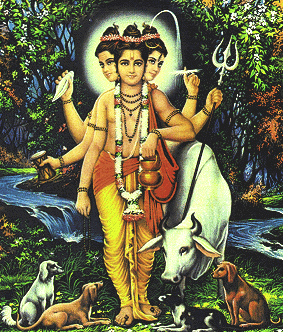
Why is He called Dattatreya?
Because the Lord, being extremely pleased with the sage (rishi) Atri, who was performing the most difficult penance and expressed his desire to receive Him - who is Light itself - as his son, decided to give ("datta" - "given") Himself to the sage Atri ("atreya" is the corresponding case in Sanskrit from "atri" - "beyond the gunas") and his wife Anasuya ("devoid of envy"), who became the father and mother of Dattatreya.
Therefore, he who knows this secret meaning, knows everything ("all the Vedas"). He who always meditates on the transcendental, Which is That, becomes the knower of Brahman. Here such shlokas come to mind:
1. [He who always meditates on the God of gods and the Eternal as] Dattatreya (Dattatreyam) – the blissfully serene (shivam), the peaceful (shchantam), shining with the dark blue color of sapphire (indranilanibham), the great Lord (prabhum), enjoying bliss in His own creation – maya (Atmamayaratam), the divine (devam), the philosopher-avadhuta (avadhutam), with four sides light as His garment (digambaram);
2. With a body covered with sacred ash (bhasmoddhulita sarvangam), with matted hair (jata jutadharam), the Supreme Lord (vibhum), four-armed (chatur-bahum; in this Upanishad Dattatreya is mentioned as four-armed, in contrast to His generally accepted form as six-armed or two-armed in other scriptures), possessing remarkable limbs (udarangam), with eyes resembling the petals of a fully opened lotus (praphulla kamaleksanam);
3. Possessing the wealth of spiritual knowledge and yoga (jnana yoganidhim), the universal teacher (visvagurum), dear to the yogis (yogijanapriyam), compassionate to the devotees (bhaktanukampinam), the witness of everything (sarvaskshinam), one for whom the holy sages render service (siddhasevitam);
4. He who always meditates thus on the God of gods and the Eternal, becomes free from all sins and attains liberation.
Om Satyam (Truth).
Thus ends the third chapter.
Om! O devas, let our ears hear what is auspicious;
May our eyes see what is auspicious, O ye worthy of worship!
May we enjoy the life span allotted by the devas,
Praising them unwaveringly with our bodies and limbs!
May the glorious Indra bless us!
May the omniscient Sun bless us!
May Garuda, the thunderstorm of the evil and wicked, bless us!
May Brihaspati grant us prosperity and good fortune!
Om! Let peace be in me!
May peace be in my surroundings!
Let peace be in those forces that act upon me!
Thus ends the Shandilya Upanishad, included in the Atharva Veda.
